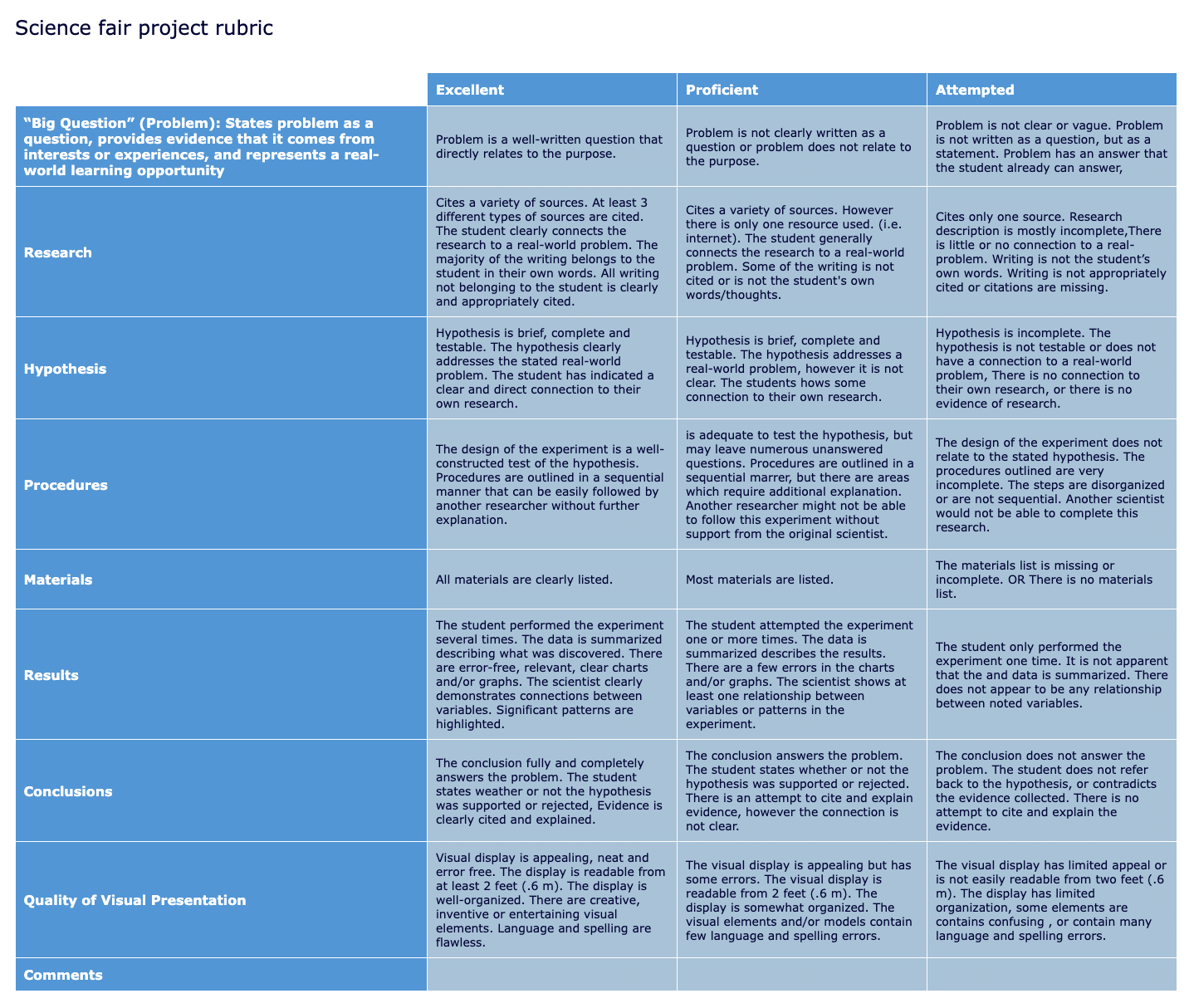
An effective assessment rubric helps teachers evaluate student work fairly, communicate expectations clearly, and provide feedback that supports learning. Whether you are grading essays, presentations, research projects, practical activities, or group assignments, a well-designed rubric makes it easier to judge performance against consistent standards. It also helps students understand what quality work looks like before they begin an assignment.
Learning how to create an assessment rubric involves more than making a table and assigning points. Teachers need to identify the learning objectives, choose meaningful assessment criteria, describe different levels of performance, and establish a scoring system that students can understand. When these elements work together, a rubric can improve transparency, consistency, and the usefulness of feedback.
This guide explains how to design an assessment rubric step by step, with practical examples, common mistakes to avoid, and strategies for using rubrics to improve teaching and learning.
What Is an Assessment Rubric?
An assessment rubric is a scoring guide that describes the criteria used to evaluate a student’s work and explains what different levels of performance look like. It provides a structured way to judge whether an assignment meets its intended learning goals.
Most rubrics contain three main components:
- Assessment criteria: The specific qualities or skills being evaluated, such as argument development, subject knowledge, organization, or use of evidence.
- Performance levels: Categories that describe different degrees of achievement, such as excellent, proficient, developing, and beginning.
- Descriptors or scoring guidelines: Statements explaining what performance at each level looks like, sometimes accompanied by points or percentages.
For example, a presentation rubric might assess content accuracy, organization, delivery, visual support, and responses to questions. Each criterion has performance descriptions that help teachers distinguish strong work from work that needs improvement.
Rubrics can be used for formative assessment, where the goal is to guide learning during a task, and summative assessment, where teachers evaluate achievement at the end of a unit or course.
Step 1: Identify the Learning Objectives
Before deciding how to score an assignment, determine what students should learn or demonstrate. The rubric should measure the skills and knowledge that matter most for the task.
Start by reviewing the assignment instructions, curriculum standards, and learning objectives. Ask yourself what successful completion should demonstrate. For an academic essay, the objectives might include constructing a clear argument, supporting claims with relevant evidence, organizing ideas logically, and using appropriate academic language.
Avoid evaluating skills that are unrelated to the learning goals. For example, if an assignment assesses scientific reasoning, neat handwriting should not receive substantial weight unless presentation is an explicit objective.
A useful way to begin is to complete this sentence: “By completing this assignment, students should be able to…” The answer helps you identify the abilities the rubric needs to assess.
Clear objectives make the rest of the design process easier because every criterion and performance descriptor can be connected to a specific educational purpose.
Step 2: Choose Clear and Relevant Assessment Criteria
Assessment criteria explain which aspects of the work will be evaluated. Select criteria that directly reflect the learning objectives and are important to the assignment’s success.
For a research paper, appropriate criteria might include:
- Quality and clarity of the central argument.
- Accuracy and depth of subject knowledge.
- Relevance and credibility of supporting evidence.
- Organization and coherence.
- Citation practices and academic integrity.
- Grammar and academic style, when relevant to the learning objectives.
Each criterion should measure a distinct aspect of performance. Overlapping criteria can cause the same weakness to be penalized multiple times. For example, “organization,” “logical structure,” and “paragraph sequence” may be too similar to score independently unless their meanings are clearly distinguished.
Use specific labels rather than vague terms. “Use of evidence” is more informative than “quality,” while “explains how evidence supports the main claim” is more precise still.
It is also important to limit the number of criteria. A rubric with too many categories can become difficult to use and may distract from the assignment’s main learning goals. Select the criteria that matter most, and make sure students can understand them without needing a lengthy explanation.
Step 3: Select the Right Type of Rubric
Different assignments require different rubric formats. Choosing the right type depends on whether you need an overall judgment, detailed feedback, or a balance between the two.
Analytic Rubric
An analytic rubric scores each criterion separately. A research paper, for example, might receive distinct scores for argument, evidence, organization, and writing style.
This format is useful when teachers want detailed feedback or need to identify students’ specific strengths and weaknesses. It can take longer to design and apply, but it provides a clearer picture of performance across different skills.
Holistic Rubric
A holistic rubric assigns one overall rating based on the quality of the work as a whole. Instead of scoring several criteria independently, the teacher selects the performance description that best matches the submission.
Holistic rubrics can be useful for short responses, broad performance tasks, or situations where an overall judgment is more important than separate scores. However, they provide less detail about which skills need improvement.
Single-Point Rubric
A single-point rubric describes the expected standard for each criterion, leaving space for teachers to record strengths and areas for improvement. It focuses on what successful work should demonstrate rather than listing detailed descriptions for every possible performance level.
This format can support descriptive feedback and student reflection, particularly when teachers want to encourage revision.
Choose the format that best matches the task, available grading time, and type of feedback students need.
Step 4: Define Performance Levels
Performance levels show how well a student meets each criterion. Many rubrics use four levels, although three or five may be appropriate depending on the assignment.
Common labels include:
- Exemplary: The work demonstrates strong understanding and consistently meets or exceeds the intended standard.
- Proficient: The work meets the expected standard with only minor weaknesses.
- Developing: The work shows partial understanding but has noticeable gaps or inconsistencies.
- Beginning: The work demonstrates limited understanding or requires substantial improvement.
The labels themselves are not enough. Students need descriptions that explain the difference between levels. Avoid relying only on words such as “good,” “average,” or “poor,” because these terms can be interpreted differently by different teachers.
Make the levels logically consistent. A student should be able to see what changes as performance improves, such as moving from an unsupported claim to a claim supported by relevant evidence and clear explanation.
Step 5: Write Observable Performance Descriptors
Performance descriptors are the statements that explain what a particular level looks like for each criterion. They are central to an effective assessment rubric because they guide both grading and improvement.
Consider the criterion “use of evidence” in a research essay.
| Performance level | Example descriptor |
|---|---|
| Exemplary | Integrates relevant, credible evidence and clearly explains how it supports the argument. |
| Proficient | Uses relevant evidence to support most claims, with generally clear explanation. |
| Developing | Includes some relevant evidence, but connections to the argument are inconsistent or underexplained. |
| Beginning | Provides little relevant evidence or does not explain how the evidence supports the argument. |
These descriptors are more useful than assigning a numerical score to “evidence quality” without explaining what that score means.
Use language that describes observable work. Terms such as “identifies,” “explains,” “compares,” “supports,” and “analyzes” make expectations clearer. Avoid descriptors that judge a student’s personality, effort, or presumed ability rather than the quality of the submitted work.
Also ensure that each level describes a meaningful difference in performance. If the descriptions for adjacent levels are nearly identical, graders may struggle to decide which score is appropriate.
Step 6: Establish a Fair Scoring System
Once the criteria and performance levels are defined, decide how scores will be assigned. A simple system may award four points for exemplary work, three for proficient work, two for developing work, and one for beginning work. Some rubrics use percentages or weighted points instead.
Not every criterion necessarily deserves equal weight. In a research assignment, the quality of the argument and use of evidence might be more important than formatting details. Assign weights according to the learning objectives, not simply according to which criteria are easiest to score.
For example, a 100-point research paper rubric might allocate:
- Argument and thesis: 30 points.
- Evidence and analysis: 30 points.
- Organization: 20 points.
- Academic style and clarity: 10 points.
- Citation and formatting requirements: 10 points.
These values are illustrative rather than universal. Adjust the distribution to fit the assignment and explain the scoring rules before students begin.
Check that the total points add up correctly and that the method for calculating the final grade is easy to follow. If some criteria have different weights, provide a clear explanation so students can understand how their work will be evaluated.
Step 7: Review the Rubric for Fairness and Accessibility
A rubric should measure the intended learning outcomes without introducing irrelevant barriers. Review each criterion to make sure it does not unintentionally favor a particular writing style, background, or way of participating when that characteristic is not part of the learning objective.
Use plain language and explain any specialist terminology. Students should be able to understand what is expected, even if they are unfamiliar with assessment jargon.
Consider accessibility when designing the assignment itself. If students can demonstrate the required knowledge through more than one permitted format, make sure the rubric evaluates the same essential learning objectives across those formats. Any alternative format should preserve the intended standard rather than quietly changing what is being assessed.
For group projects, distinguish individual accountability from team performance when both matter. A shared score may reflect the final product, while individual reflection or contribution evidence can help assess each student’s learning.
Finally, review the rubric for bias, unclear expectations, and criteria that might unintentionally reward resources students were never expected to have.
Step 8: Test and Refine the Rubric
Before using a rubric for a major assignment, test it against sample work or examples from previous tasks, where appropriate. This helps reveal unclear descriptors and scoring rules that do not work as intended.
If several teachers will use the same rubric, discuss how you would score a sample submission. Compare decisions and identify where interpretations differ. This process, often called calibration, can improve consistency across graders.
Ask students whether the criteria and performance descriptions are understandable. Their questions may reveal expectations that seemed obvious to the teacher but were not clear to the class.
After grading, review whether the rubric helped distinguish different levels of work. If most students receive the same score for a criterion, check whether the descriptors are too broad or whether the task provided enough opportunity to demonstrate different levels of performance.
Treat the rubric as a tool that can be improved. Small revisions based on actual classroom experience can make future assessment clearer and more useful.
Common Mistakes to Avoid
Even carefully planned rubrics can create problems when their design is unclear. Avoid these common mistakes:
Using vague descriptors. Replace subjective words such as “excellent” with specific descriptions of the work students should demonstrate.
Including too many criteria. Focus on the most important learning outcomes instead of scoring every small feature of an assignment.
Overlapping criteria. Make sure each category measures a distinct skill to avoid double-penalizing the same weakness.
Giving every criterion equal weight automatically. Weight criteria according to their importance to the learning objectives.
Sharing the rubric too late. Provide it before students begin so they can use it to plan, monitor, and improve their work.
Ignoring student feedback. Review common questions and grading difficulties to identify where instructions need improvement.
Treating the score as the only feedback. Explain what students did well and what they can do next, especially when the rubric is used to support learning.
How to Use an Assessment Rubric to Improve Learning
An assessment rubric is most valuable when it becomes part of the learning process rather than a document used only after an assignment is submitted.
Share the rubric in advance and discuss examples of work that illustrate different performance levels. Encourage students to use the criteria to plan their approach, review a draft, or check whether they have met the assignment’s main expectations.
Rubrics can also support peer assessment. Students can use the same criteria to give each other focused feedback, provided they understand the standards and know how to explain their judgments respectfully.
After returning graded work, connect comments to the relevant criteria. Instead of writing “needs improvement,” explain which part of the argument requires more evidence or where the organization makes the reasoning difficult to follow. Students can then use that information in future assignments.
Teachers can also analyze patterns in rubric results. If many students struggle with the same criterion, it may indicate a need for additional instruction, clearer directions, or more opportunities to practice that skill.
Conclusion
Learning how to create an assessment rubric starts with clear learning objectives and continues through careful selection of criteria, performance levels, descriptors, and scoring rules. A strong rubric makes expectations visible, supports more consistent grading, and helps students understand how to improve their work.
The most effective rubrics are specific enough to guide decisions but simple enough to use efficiently. They evaluate meaningful learning outcomes, avoid unnecessary complexity, and provide feedback students can act on. By testing rubrics, reviewing their fairness, and refining them after use, teachers can build assessment tools that support both reliable evaluation and better learning.
Leave a Reply