Finding information for a research paper is easier than ever, but finding information you can trust takes careful judgment. Students can access academic journals, university websites, online reports, blogs, and social media posts within seconds. However, not every source is accurate, relevant, or suitable for academic work.
Learning how to evaluate academic sources helps you distinguish reliable evidence from unsupported claims, recognize potential bias, and build stronger research papers. It also helps you avoid citing outdated information, misleading statistics, or publications that do not support your argument.
This guide explains how to evaluate academic sources step by step, recognize credible research, verify information online, and decide whether a source belongs in your assignment.
What Makes an Academic Source Credible?
A credible academic source provides information that can be examined, verified, and assessed in context. It usually identifies its author or responsible organization, explains where its information comes from, and supports its conclusions with appropriate evidence.
Examples of academic sources include:
- Peer-reviewed journal articles.
- Scholarly books published by reputable academic publishers.
- Research reports from established institutions.
- Conference papers relevant to your discipline.
- Government or university research publications.
- Systematic reviews and other evidence-based scholarly reviews.
However, a source is not automatically reliable just because it appears in an academic journal or on a university website. You still need to examine its methodology, relevance, publication history, and potential limitations.
Likewise, a source does not become unreliable simply because it is freely available online. Credibility depends on the quality of the evidence and the context in which the information is used.
Why Is Evaluating Academic Sources Important?
Source evaluation is a fundamental research skill because the quality of your evidence affects the strength of your conclusions.
Carefully evaluating sources helps you:
- Improve research accuracy: Identify claims supported by evidence rather than assumptions.
- Avoid misinformation: Recognize misleading, incomplete, or outdated information.
- Strengthen academic arguments: Support your points with appropriate research.
- Identify bias: Understand how funding, affiliations, or publication goals may influence a source.
- Save research time: Focus on sources that directly answer your research question.
- Maintain academic integrity: Represent other researchers’ findings accurately and cite them correctly.
A well-written paper depends not only on the number of sources you collect but also on how carefully you select and interpret them.
1. Check the Author’s Qualifications and Expertise
The first step in evaluating a source is to identify who created it and whether they have relevant expertise.
Look for the author’s name, academic qualifications, institutional affiliation, professional experience, and previous publications. For specialized subjects, such as medicine, engineering, or education research, relevant subject knowledge matters more than general popularity.
For example, a peer-reviewed study on classroom assessment written by researchers with experience in educational measurement may be more useful than an anonymous blog post offering unsupported claims about teaching methods.
However, qualifications alone do not guarantee accuracy. An expert can make mistakes, interpret evidence differently from other researchers, or have a financial or professional interest in a particular outcome.
Questions to ask:
- Is the author identified?
- Do they have relevant qualifications or experience?
- Have they published other work on the subject?
- Are their institutional affiliations disclosed?
- Is there evidence of a potential conflict of interest?
If the author is anonymous or their expertise cannot be verified, investigate the source more carefully before using it.
2. Examine the Publication and Publisher
The publisher can provide useful clues about a source’s reliability. Academic journals, university presses, scholarly societies, and established research institutions often have editorial processes designed to assess the quality of published material.
When evaluating a journal article, investigate the journal’s scope, editorial board, peer-review policy, and publication standards. Check whether the article type is actually peer-reviewed: editorials, letters, and commentary pieces may follow different procedures from original research articles.
Be cautious of journals that promise guaranteed acceptance, advertise implausibly fast publication, or provide little information about their editorial process.
You can also check whether the journal is listed in relevant scholarly databases or recognized indexing services. Indexing is a useful clue, but it is not a substitute for evaluating the individual article.
Remember that peer review is a quality-control process, not a guarantee that every finding is correct. Published research can contain errors, limitations, or conclusions that later studies challenge.
3. Evaluate the Accuracy of the Evidence
A credible source should provide a reasonable basis for its claims. Depending on the publication, that may include data, documented observations, citations, a transparent methodology, or a carefully supported analysis.
Do not accept a statement merely because it sounds scientific or includes statistics.
Instead, ask:
- Does the author provide evidence for the main claims?
- Are relevant studies and references identified?
- Can the reported findings be traced to the original research?
- Do the conclusions match the evidence presented?
- Are important limitations acknowledged?
- Can key facts be checked against independent, reputable sources?
For a research study, examine how the data were collected and analyzed. Consider whether the sample, methods, and measures are appropriate for the research question.
For example, a survey involving a small group of volunteers may provide useful insights into their experiences, but it may not justify a claim about every university student. The conclusions should reflect the limits of the study.
If an article cites a statistic without identifying its original source, look for the underlying report or dataset before using that number in your paper.
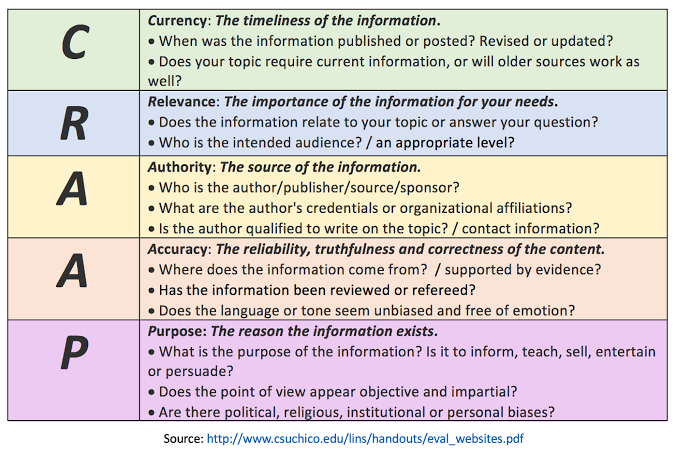
4. Use the CRAAP Test to Evaluate Sources
The CRAAP test is a practical checklist that helps students assess five important features of a source: Currency, Relevance, Authority, Accuracy, and Purpose. It is widely used in academic library instruction. <Cite refs={[“turn345701search0″,”turn345701search2”]}/>
Currency: Is the information up to date?
Check when the source was published and whether it has been revised.
The appropriate date depends on your topic. Research on current educational technology or public policy may require recent evidence, while a historical analysis may rely on older primary documents.
Ask whether newer evidence has changed the discussion and whether the source remains suitable for your assignment.
Relevance: Does it answer your research question?
A credible source may still be unsuitable for your paper if it does not address your topic directly.
Check whether it covers the right subject, population, setting, and level of detail. Consider whether the source helps answer your question or simply mentions a related keyword.
Authority: Who is responsible for it?
Investigate the author, publisher, qualifications, and affiliations. Look for relevant expertise and information that helps you assess the source’s background.
Do not judge authority from a website’s design or domain extension alone. A professional appearance does not prove that the content is accurate.
Accuracy: Is it supported by evidence?
Look for documented facts, appropriate methods, references, and conclusions that follow logically from the evidence.
Compare important claims with independent sources. If a claim cannot be verified, treat it cautiously rather than repeating it as an established fact.
Purpose: Why was it published?
Consider whether the source aims to inform, educate, entertain, sell, persuade, or advocate for a particular position.
Look for sponsorship, advertising, funding, conflicts of interest, and language designed to provoke a strong emotional reaction.
A source can have a clear perspective and still provide valuable evidence. The important question is how that perspective affects what is included, emphasized, or omitted.
5. Verify Online Sources With Lateral Reading
Lateral reading means leaving the source you are examining to investigate it elsewhere. Instead of relying only on what a website says about itself, you search for independent information about its author, organization, claims, and reputation.
This approach is particularly useful when evaluating unfamiliar websites, viral claims, and online reports. <Cite refs={[“turn345701search4″,”turn345701search5”]}/>
Follow these steps:
- Pause before accepting the claim. Do not assume the first search result is the most reliable.
- Search for the author or organization. Look for independent reporting, institutional profiles, or credible evaluations.
- Find better coverage. Check whether reputable academic, professional, or public-interest sources discuss the same issue.
- Trace claims to their origin. Locate the original study, dataset, report, or quotation.
- Compare the evidence. Determine whether independent sources support the claim and whether they use the same context.
For example, if a website states that a new teaching technique dramatically improves student performance, search for the original study. Examine the sample, research design, reported results, and limitations instead of relying solely on the website’s summary.
Lateral reading does not mean that every claim needs dozens of searches. Focus your verification efforts on claims that are important, surprising, controversial, or difficult to check.
6. Understand Bias, Funding, and Conflicts of Interest
Bias can affect which questions researchers investigate, how results are interpreted, and which findings receive attention.
Funding from a company, advocacy organization, or other interested party does not automatically invalidate a study. However, understanding who funded the research and whether the authors disclose conflicts of interest can help you interpret the results.
Consider these questions:
- Who funded the study or publication?
- Do the authors disclose relevant financial or professional relationships?
- Does the article acknowledge evidence that challenges its conclusions?
- Are alternative explanations considered?
- Does the language present evidence fairly or exaggerate the findings?
For instance, research funded by a company evaluating its own educational software deserves careful examination of the study design, outcome measures, and disclosure statements. Its findings may be useful, but independent evidence can help you assess how broadly the conclusions should be applied.
Also consider your own assumptions. You may be more likely to accept a source that supports your existing opinion. Evaluating opposing evidence helps you develop a more balanced academic argument.
7. Check the Research Methodology and Limitations
When using empirical research, do not focus only on the abstract or conclusion. Read the methods and limitations sections to understand how the researchers reached their findings.
Look for:
- The research question and design.
- The number and characteristics of participants or observations.
- How data were collected.
- The measures used to assess outcomes.
- The analytical methods.
- The limitations acknowledged by the authors.
Different research designs answer different questions. A randomized experiment may help investigate causal effects under particular conditions, while interviews may provide deeper insight into people’s experiences. Neither approach is automatically superior in every context.
Be especially careful when an article claims that two variables are related. An association does not, by itself, establish that one variable caused the other.
If the sample is limited to one institution or location, consider whether the findings can reasonably be applied to a wider population.
8. Check Whether the Source Has Been Corrected or Retracted
Research publications sometimes receive corrections, expressions of concern, or retraction notices after publication. These updates can change whether and how an article should be used.
Before relying heavily on a research paper:
- Check the publisher’s article page for correction or retraction notices.
- Review any linked editorial statements.
- Search the article title and DOI alongside terms such as “correction” or “retraction” when appropriate.
- Check whether later research has challenged or failed to reproduce important findings.
A retracted article may still be discussed in a paper about the history of a field, research misconduct, or the development of scientific knowledge. However, it should not normally be treated as reliable evidence for the original scientific claim without clearly explaining its status.
For important findings, look for later studies and reviews that assess the wider evidence rather than relying on a single publication.
9. Decide Whether a Source Belongs in Your Research Paper
After evaluating a source, decide how it should be used. Not every source that passes basic credibility checks deserves a place in your final bibliography.
A useful source should be both credible and relevant to your particular research question.
For example, an authoritative government report may be ideal for official statistics, while a peer-reviewed experiment may be more suitable for evaluating a specific intervention. A textbook may explain foundational concepts, but a recent journal article may be better for discussing emerging research.
You can classify your sources as follows:
- Use: The source is relevant, sufficiently reliable, and appropriate for the claim you want to support.
- Use with caution: The source offers useful information but has limitations, possible bias, or restricted applicability.
- Seek stronger evidence: Important claims are unsupported, methods are unclear, or independent verification is lacking.
- Exclude: The source is irrelevant, materially misleading, unverifiable, or unsuitable under your assignment’s requirements.
Keep notes about why you selected important sources. This makes it easier to explain your research decisions and avoid repeating the same evaluation work later.
Common Mistakes When Evaluating Academic Sources
Avoid these common errors when researching for an assignment:
- Trusting the top search result: Search ranking does not establish academic credibility.
- Assuming every peer-reviewed article is correct: Review the methods, evidence, and limitations.
- Judging by the domain name alone: A domain extension does not prove that a particular claim is reliable.
- Ignoring publication dates: Old evidence may be inappropriate for fast-changing subjects.
- Reading only the abstract: Important methodological details and limitations may appear elsewhere in the paper.
- Accepting statistics without tracing them: Find the original report or dataset whenever possible.
- Using only sources that agree with you: Evaluate competing evidence and alternative explanations.
- Ignoring corrections or retractions: Verify the current status of important research papers.
Academic Source Evaluation Checklist
Before citing a source, use this checklist to review it.
- The author or responsible organization is identifiable.
- The author has relevant expertise or the source provides another credible basis for its authority.
- The publication process is appropriate for the type of material.
- The source directly supports my research question.
- The claims are supported by evidence I can examine.
- The methods and limitations are suitable for the conclusions.
- The publication date is appropriate for my topic.
- The purpose, funding, and possible conflicts of interest have been considered.
- Important claims have been checked against independent sources.
- I have checked for relevant corrections or retractions where necessary.
- I can cite the source accurately and explain why it is useful.
You do not need every source to be perfect. You do need to understand its strengths, limitations, and appropriate role in your paper.
Frequently Asked Questions
What is the easiest way to evaluate academic sources?
Start with the CRAAP test: check Currency, Relevance, Authority, Accuracy, and Purpose. Then use lateral reading to verify the author, organization, and important claims through independent sources.
Is Google Scholar enough to find credible sources?
Google Scholar is useful for discovering scholarly literature, but inclusion in its results does not guarantee that every item is peer-reviewed or reliable. Check the original publication, author, research methods, and publication status before citing it.
Are peer-reviewed articles always credible?
Peer review adds a layer of expert scrutiny, but it does not eliminate errors, bias, weak methods, or later corrections. Evaluate the individual article and its evidence.
Can I cite a university website in an academic paper?
Yes, if the information is relevant, authoritative, and appropriate for your assignment. A university website may be useful for official policies or educational guidance, but a research question about a scientific finding may require the original study or a scholarly review.
How many sources should I check before choosing one?
There is no fixed number. Compare enough independent evidence to judge the source and support the claim you want to make. Important or controversial claims usually require more careful verification than routine background information.
What should I do if two credible sources disagree?
Compare their dates, research questions, methods, populations, measurements, and limitations. The apparent disagreement may reflect different circumstances or outcomes. Explain the uncertainty fairly rather than choosing one source simply because it supports your argument.
Conclusion
Learning how to evaluate academic sources is essential for producing accurate, credible, and persuasive research. Check the author’s expertise, examine the publisher, assess the evidence, and consider the source’s purpose and possible limitations.
Use the CRAAP test as a practical starting point, then apply lateral reading to verify important claims independently. For research studies, investigate the methodology, limitations, and publication status before relying on the findings.
The goal is not simply to collect sources that look academic. It is to select evidence that genuinely supports your research question and to use that evidence responsibly. These habits will help you write stronger assignments, make better research decisions, and develop critical thinking skills that extend beyond university.
Leave a Reply