A strong thesis statement is the foundation of a well-organized academic essay. It tells readers the main point of your paper, establishes its direction, and helps you decide which ideas and evidence belong in your discussion. Whether you are writing an argumentative essay, literary analysis, research paper, or assignment for a university course, a clear thesis can make your writing more focused and persuasive.
Learning how to write a strong thesis statement involves more than summarizing a topic. You need to develop a specific central idea, explain what you want to demonstrate, and make sure your essay can support that idea with relevant evidence.
This guide explains how to create an effective thesis statement, provides practical examples, and highlights common mistakes to avoid.
What Is a Thesis Statement?
A thesis statement is the central claim, interpretation, or main idea that guides an academic essay. It tells readers what your paper is about and what you want them to understand by the end.
In an argumentative essay, a thesis usually presents a position that you will defend with evidence. In an analytical essay, it communicates your interpretation of a subject. In an explanatory paper, it identifies the main point your discussion will develop.
For example:
Weak thesis: Social media affects students.
Stronger thesis: Excessive social media use can disrupt university students’ concentration by encouraging frequent task-switching and interrupting focused study sessions.
The stronger example identifies a specific issue and explains the relationship the essay will examine. It also gives the writer a clear direction for developing the main sections.
A thesis statement commonly appears near the end of the introduction, although its placement can vary depending on the assignment, discipline, and writing style.
Why Is a Strong Thesis Statement Important?
An effective thesis helps both the writer and the reader understand the purpose of an essay.
- Provides direction: It establishes the central idea that your paragraphs should develop.
- Improves organization: It helps you arrange supporting points in a logical order.
- Clarifies your purpose: It explains what your essay aims to demonstrate, interpret, or explain.
- Guides research: It helps you identify which sources and evidence are relevant.
- Creates reader expectations: It gives readers a clear idea of what the essay will discuss.
Without a clear thesis, an essay may contain useful information but lack a central argument. A focused statement helps connect individual paragraphs to one overall purpose.
Characteristics of a Strong Thesis Statement
Before learning the writing process, understand the features that distinguish an effective thesis from a vague or overly broad one.
1. It Is Specific and Focused
A thesis should identify a manageable issue rather than cover an entire subject.
Too broad: Technology has changed education.
More focused: Interactive online simulations can help biology students visualize complex processes when they are combined with guided practice and instructor feedback.
The revised statement gives the essay a narrower subject and identifies specific aspects to investigate.
2. It Presents a Clear Main Idea
Readers should be able to identify the central point without guessing what the writer means.
Unclear: There are many interesting things to consider about university attendance.
Clearer: Flexible attendance policies can support university students with unavoidable work and caregiving responsibilities, provided that essential learning activities remain accessible.
The second statement communicates a specific position and introduces a condition that the essay can examine.
3. It Is Defensible With Evidence
An argumentative thesis should make a claim that can be examined, questioned, or supported through reasoning and evidence.
Weak: Reading is important.
Stronger: Schools should provide structured independent-reading time because it gives students regular opportunities to develop reading fluency, explore their interests, and practice comprehension.
The stronger version gives readers reasons to consider and evaluate the position.
Not every academic paper needs a controversial argument. An explanatory or analytical assignment may require a clear interpretation or central conclusion instead.
4. It Matches the Assignment
Your thesis must answer the question your instructor has asked.
If the prompt asks you to compare two learning methods, a statement that only describes one method will not fully address the task. Read the assignment carefully, identify its main instruction, and shape your thesis around that requirement.
5. It Is Manageable Within the Available Space
A short essay cannot thoroughly investigate every aspect of a complicated subject. Choose a claim that you can develop using the available word count, sources, and time.
A focused argument usually produces a more coherent essay than an ambitious statement that promises more than the paper can demonstrate.
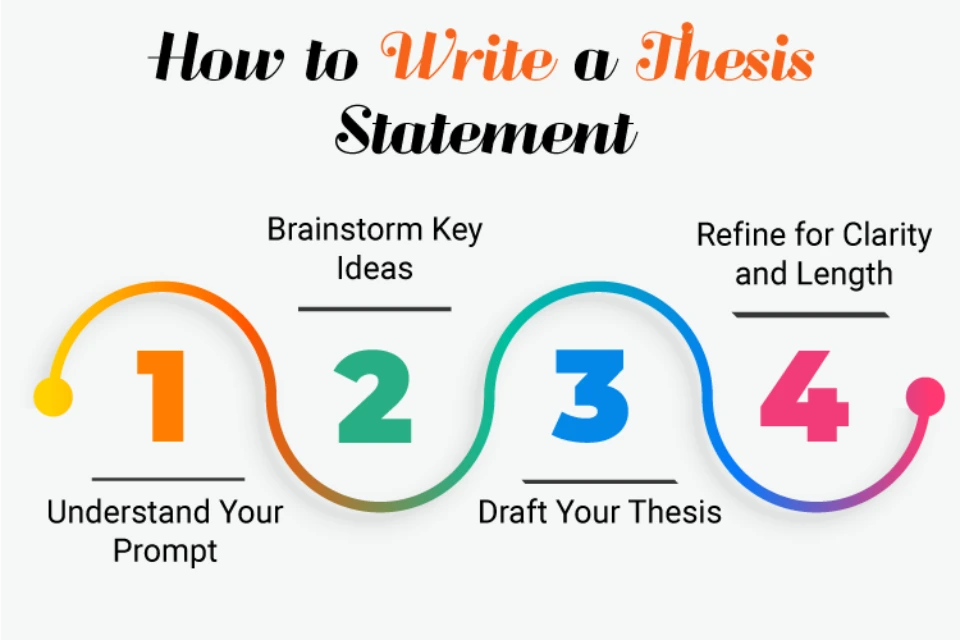
How to Write a Strong Thesis Statement Step by Step
Follow this practical process when planning an academic essay.
Step 1: Understand the Essay Prompt
Begin by identifying the task. Are you being asked to argue, analyze, compare, evaluate, or explain?
For example, a prompt might ask you to evaluate whether group projects improve university learning. Your thesis should offer an evaluation rather than merely define group projects.
Underline the main topic and identify what your instructor expects you to do with it.
Step 2: Narrow Your Topic
Broad subjects are often difficult to develop in a short paper. Narrow your topic by considering a particular group, setting, problem, cause, or outcome.
Suppose your initial topic is online learning. You could narrow it to online learning for first-year university students, then focus further on how instructor feedback affects participation.
A narrower topic makes it easier to formulate a meaningful central idea and select appropriate evidence.
Step 3: Ask a Question About Your Topic
Turn your subject into a question that your essay can answer.
For example:
Topic: Recorded university lectures.
Research question: How do recorded lectures affect students who need to review difficult course material?
Your answer to this question can become the starting point for your thesis. If the evidence changes your understanding, you can revise the statement as your research develops.
Step 4: Develop a Preliminary Answer
Write a direct answer to your question in one sentence. Do not worry about making it perfect at this stage.
Preliminary answer: Recorded lectures help students review difficult material.
This is a useful starting point, but it needs more precision. Think about which students benefit, under what circumstances, and why.
Step 5: Add a Specific Claim and Supporting Reasoning
Improve your preliminary answer by identifying the main reason behind your position.
Revised thesis: Recorded university lectures can support students’ understanding of difficult course material by allowing them to revisit explanations and review challenging concepts at their own pace.
This version explains how the practice may help students and gives the essay a direction. The final paper should support the claim with appropriate evidence rather than assuming the benefit applies equally to every student.
Step 6: Check Your Evidence
Ask whether you can find reliable evidence to support your statement. Consider academic research, relevant examples, assigned readings, and credible sources.
If you cannot support the claim, you may need to narrow it, change your position, or gather more information.
A thesis should guide your research, but it should not prevent you from reconsidering your original idea when the evidence points elsewhere.
Step 7: Revise After Drafting
Your understanding of a topic often improves while writing. Once you have drafted the main sections, compare your essay with your thesis.
Does every major section contribute to the central idea? Does your evidence support the claim you initially made? If the essay has developed in a different direction, revise the thesis to reflect what the paper actually demonstrates.
Strong Thesis Statement Examples for Different Essays
The best thesis format depends on the assignment. These examples show how a central idea can be expressed across different academic writing styles.
Argumentative Essay
Topic: University attendance policies.
Thesis: Universities should offer reasonable attendance flexibility for students facing documented personal or health-related challenges while maintaining clear academic participation requirements.
This statement takes a position and establishes the balance the essay will examine.
Analytical Essay
Topic: A character in a novel.
Thesis: The protagonist’s changing relationship with authority reveals how fear of social rejection can influence personal decisions.
This thesis presents an interpretation that the essay can develop through close analysis of the text.
Compare-and-Contrast Essay
Topic: Printed and digital textbooks.
Thesis: Although printed and digital textbooks provide access to the same course material, their differences in navigation, portability, and annotation options can influence how students study.
This statement identifies the comparison and the dimensions the essay will explore.
Explanatory Essay
Topic: Urban heat islands.
Thesis: Urban heat islands develop when built surfaces absorb and retain heat, while limited vegetation reduces the cooling effects of shade and evaporation.
This thesis identifies the main explanation the essay will develop. For a scientific paper, claims should be supported by appropriate research.
Research Paper
Topic: Student participation in online courses.
Thesis: Student participation in online courses is shaped by several interacting factors, including course design, opportunities for interaction, and the clarity of learning expectations.
This statement identifies a focused area of investigation without claiming that one factor explains every student’s experience.
Common Thesis Statement Mistakes to Avoid
Even a promising idea can become ineffective if it is expressed poorly. Watch out for these common problems.
- Being too vague: Replace broad claims with a specific interpretation, position, or explanation.
- Announcing the essay instead of stating its point: Instead of writing “This essay will discuss online learning,” explain what your essay will show about online learning.
- Including unrelated ideas: Keep the thesis centered on one main argument or connected purpose.
- Making unsupported claims: Avoid statements that require evidence you cannot reasonably obtain.
- Using overly absolute language: Words such as “always,” “never,” and “everyone” may make a claim unnecessarily difficult to defend.
- Treating your first draft as final: Revisit your thesis after researching and drafting the essay.
- Ignoring the assignment prompt: A well-written statement is still ineffective if it answers the wrong question.
Thesis Statement Checklist Before You Submit
Use this checklist to review your thesis before handing in your essay.
- Does it answer the assignment question?
- Is the main idea clear and specific?
- Does it match the type of essay I am writing?
- Can I support it with evidence and logical reasoning?
- Is the topic narrow enough for the available word count?
- Do the main sections of my essay develop this idea?
- Have I removed unnecessary wording and vague expressions?
- Does the thesis accurately represent my completed paper?
If you answer “no” to any question, revise the statement before completing your final draft.
Frequently Asked Questions
How long should a thesis statement be?
For many short academic essays, one well-developed sentence is enough. Longer research papers may need a more detailed statement or a short thesis paragraph. Follow your assignment guidelines and prioritize clarity over length.
Where should a thesis statement appear?
It commonly appears near the end of the introduction, where it prepares readers for the main discussion. However, some disciplines and assignments use different structures.
Can a thesis statement be a question?
A research question can guide your investigation, but most argumentative essays need a statement that answers the question and communicates the central claim. Other academic formats may use different conventions.
Can I change my thesis after writing the essay?
Yes. A thesis is often a working statement that develops as you read, research, and write. Revising it helps ensure that the final version accurately reflects your evidence and conclusions.
Does every academic essay need a thesis statement?
Many academic essays need a clear central idea, but its form depends on the assignment. A reflective essay, for example, may use a personal insight, while a research essay may present an analytical claim. Follow your instructor’s requirements.
Final Thoughts
Writing a strong thesis statement begins with understanding the assignment, narrowing the topic, and answering a focused question. The statement should communicate a clear central idea, fit the scope of your paper, and provide a direction that your evidence can support.
Do not worry if your first attempt is imperfect. Develop a preliminary thesis, research your topic, draft the essay, and revise the statement when your understanding improves. With practice, you can create thesis statements that make academic writing more organized, focused, and meaningful
Leave a Reply