A literature review is an essential part of many academic research papers, dissertations, and university projects. It explains what researchers already know about a topic, compares important findings, and identifies questions that still need further investigation. A well-written literature review helps readers understand the background of your research and why your study matters.
Learning how to write a literature review involves more than collecting articles and summarizing them. You must evaluate the quality of existing research, identify relationships between studies, and organize the evidence into a clear discussion that supports your research question.
Whether you are preparing an undergraduate assignment, a graduate dissertation, or a standalone review paper, this guide explains how to plan, research, organize, and write an effective literature review.
What Is a Literature Review?
A literature review is a structured discussion of published research and other scholarly sources related to a specific topic or research question. It summarizes relevant knowledge while comparing, interpreting, and evaluating the evidence.
For example, if you are researching how online learning affects university students, your literature review might examine studies on student engagement, academic performance, instructor feedback, and access to technology.
Rather than describing each study separately, you would explain where the findings agree, where they differ, and what those patterns suggest about your research question.
A literature review may appear as a section within a research paper or dissertation, or it may be written as a standalone academic paper. Its length and structure depend on the assignment, discipline, and purpose.
Why Is a Literature Review Important?
A strong literature review establishes the academic foundation for your research. It helps you understand the existing discussion before developing your own study.
Its main purposes include:
- Providing background: Explains the key concepts, theories, and findings related to your topic.
- Identifying research gaps: Shows which questions remain unanswered or insufficiently explored.
- Comparing evidence: Highlights agreements, disagreements, and patterns across studies.
- Improving research design: Helps you identify methods, measures, and approaches used by previous researchers.
- Justifying your study: Explains how your project relates to and may contribute to existing knowledge.
A literature review also demonstrates that your research question is informed by relevant scholarship rather than developed in isolation.
Step 1: Define Your Research Question
Before searching for sources, decide what you want your literature review to investigate. A broad topic can produce too many results and make it difficult to identify relevant evidence.
For example:
Broad topic: Online learning.
More focused question: How does instructor feedback influence student engagement in online university courses?
The focused question identifies a particular factor, outcome, and educational setting. It gives you a clearer basis for deciding which studies to include.
To refine your question, ask yourself:
- What specific problem or issue am I investigating?
- Which population, setting, or subject area matters?
- What relationship, experience, or outcome do I want to understand?
- What can I realistically cover within the assignment requirements?
Your question may change as you discover more about the research. That is normal. Keep it focused enough to guide your reading while allowing room for important findings you did not initially expect.
Step 2: Search for Relevant Academic Sources
Once your research question is clear, begin searching for scholarly literature. Useful sources may include peer-reviewed journal articles, academic books, systematic reviews, conference papers, and credible reports relevant to your discipline.
Common places to search include:
- Google Scholar for discovering academic publications.
- University library databases for subject-specific research.
- PubMed for biomedical and life-science literature.
- ERIC for education research.
- JSTOR for scholarship across humanities and social sciences.
Choose databases that match your subject and the requirements of your assignment.
Use focused search terms
Start with the main concepts in your research question. Try synonyms and related phrases to find studies that use different terminology.
For example, a search about instructor feedback and online student engagement could use phrases such as:
- instructor feedback in online learning
- student engagement in virtual classrooms
- online course feedback and participation
- university e-learning student engagement
You can combine terms with Boolean operators. AND narrows a search to results containing both concepts, OR expands it to include alternatives, and quotation marks can help search for an exact phrase when supported by the database.
For instance, searching for "online learning" AND "student engagement" can help you locate research connecting those concepts.
Set sensible inclusion criteria
Do not collect sources simply because they mention your topic. Decide which sources are relevant to your question and credible enough to inform your review.
Depending on your project, you may prioritize:
- Research published within a specified date range.
- Studies involving a relevant population or setting.
- Peer-reviewed scholarly publications.
- Sources that directly investigate your main concepts.
- Foundational studies that established important theories or methods.
Recent research is particularly important in rapidly changing fields, but older studies may remain essential when they introduced influential concepts or established the background of a research area.
Step 3: Evaluate the Quality of Your Sources
Not every publication provides equally strong evidence. Before including a source, examine its credibility, relevance, methodology, and limitations.
Use the following questions as a guide:
Authority: Who conducted the research, and where was it published?
Relevance: Does the source directly help answer your research question?
Methodology: Is the research design appropriate for the question being investigated?
Evidence: Are the conclusions supported by the data and analysis presented?
Limitations: Do the authors identify weaknesses, uncertainty, or restrictions on how their findings should be interpreted?
Currency: Is the publication recent enough for your topic, or is it an important foundational work?
For empirical studies, pay attention to sample size, participant characteristics, research setting, measurement methods, and possible sources of bias. These details can help explain why two studies reach different conclusions.
A credible literature review does not automatically accept every published finding. It considers how much confidence the evidence deserves.
Step 4: Take Organized Notes While Reading
Taking structured notes saves time when you begin writing. If you rely on memory or scattered highlights, it can become difficult to compare studies accurately.
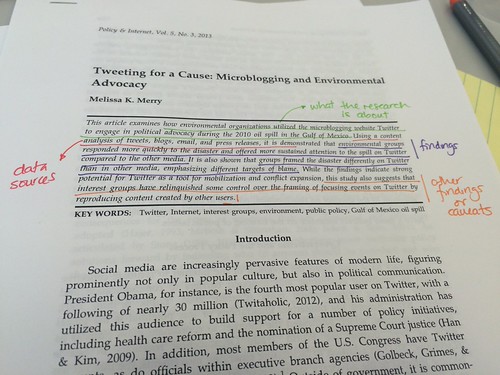
Create a literature review matrix to record key information from each source.
| Information | What to record |
|---|---|
| Citation | Author, year, title, publication, and DOI or stable link |
| Research purpose | Main question or objective |
| Methodology | Design, sample, data collection, and analysis |
| Main findings | Results relevant to your research question |
| Limitations | Weaknesses or restrictions identified in the study |
| Connection | How the source relates to other studies and your project |
For example, if three studies investigate online student engagement, your notes may reveal that they measure engagement differently. One might examine attendance, another discussion participation, and a third student-reported motivation.
Recording these distinctions helps you avoid treating findings as directly comparable when the studies measure different outcomes.
Always record citation details as you read. This reduces the risk of missing references or accidentally presenting another researcher’s ideas as your own.
Step 5: Identify Themes, Patterns, and Research Gaps
This is one of the most important stages of writing a literature review. After reading your sources, look for connections between them rather than treating each publication as an isolated piece of information.
Look for recurring themes
Group studies that investigate similar questions or report related findings. For a review of online learning, possible themes might include:
- Student motivation and engagement.
- Instructor communication and feedback.
- Technology access and digital barriers.
- Course design and learning outcomes.
These themes can become the main sections of your review.
Compare agreements and disagreements
Researchers may reach similar conclusions for different reasons, or their findings may conflict. Examine whether differences in methodology, population, context, or measurement could help explain the results.
For example, one study may report that recorded lectures improve students’ confidence, while another finds little change in examination performance. These findings are not necessarily contradictory because confidence and performance are different outcomes.
Your task is to explain what the evidence shows, what remains uncertain, and how the findings relate to one another.
Identify research gaps carefully
A research gap is an important question, population, relationship, or context that existing literature has not adequately addressed.
Possible gaps include:
- Limited research on a particular population.
- Inconsistent findings across studies.
- Few studies examining a specific setting.
- Weaknesses in commonly used research methods.
- A lack of evidence about long-term outcomes.
Do not claim that no research exists simply because you did not find it in one database. Explain the limits of your search and support any gap claim with the evidence you reviewed.
Step 6: Choose the Best Structure for Your Literature Review
The right structure depends on the purpose of your review and the nature of the literature.
Thematic structure
Organize the review around recurring concepts or topics. This is useful when several related themes emerge across the literature.
For example, a review of online learning could have sections on engagement, feedback, technology access, and assessment.
Chronological structure
Arrange sources by time to show how ideas, methods, or findings have developed. This works well when the history of a research area is important.
Avoid simply listing publications by year. Explain what changed and why those developments matter.
Methodological structure
Group studies according to the methods they use, such as surveys, interviews, experiments, or case studies. This can help you evaluate how different approaches affect the evidence.
Theoretical structure
Organize the review around theories or conceptual frameworks that researchers use to explain a problem. This is useful when competing theories offer different interpretations of the same topic.
You can combine approaches when doing so improves clarity. For many student assignments, a thematic structure is a practical starting point.
Step 7: Write the Introduction, Body, and Conclusion
Most literature reviews follow an introduction-body-conclusion structure, although the amount of space given to each section depends on whether the review is standalone or part of a larger paper.
Introduction
Introduce the topic, explain why it matters, define the scope of the review, and state its guiding question or purpose.
Briefly tell readers how the discussion is organized. If you are writing a formal systematic or scoping review, you may also need to explain the search strategy and selection criteria in a dedicated methods section.
Body
Organize the main discussion into sections based on your chosen structure. Each paragraph should develop a clear point and connect relevant sources.
A useful paragraph pattern is:
- Introduce the theme or claim.
- Present findings from relevant studies.
- Compare similarities and differences.
- Evaluate the strength or limitations of the evidence.
- Explain how the discussion relates to your research question.
This structure keeps your analysis at the center instead of turning the review into a sequence of summaries.
Conclusion
Summarize the main patterns and conclusions that emerge from the literature. Explain what is reasonably well established, what remains uncertain, and how the review informs your own project.
If relevant, identify a justified research gap or explain why further investigation is needed. Avoid introducing major new sources or making claims that the review has not established.
Step 8: Synthesize Sources Instead of Summarizing Them One by One
A common weakness is writing one paragraph about each article without explaining how the studies relate to each other.
Summary-only approach:
“Study A investigated online feedback. Study B examined student participation. Study C studied academic performance.”
This reports what the researchers did but does not develop an overall interpretation.
Synthesis approach:
“Across the reviewed studies, timely instructor feedback appears closely connected to students’ participation in online courses. However, the evidence is less consistent regarding its relationship with academic performance, partly because studies use different outcome measures and research designs.”
This example connects findings and highlights a possible reason for variation. In your own paper, support such statements with citations to the actual studies you reviewed.
Useful phrases for synthesis include:
- “Several studies suggest that…”
- “In contrast, other researchers found…”
- “A recurring pattern across the literature is…”
- “These findings differ partly in their…”
- “Taken together, the evidence indicates…”
- “An important limitation of the existing research is…”
Use these expressions only when they accurately reflect your sources. Clear synthesis requires careful reading, not just sophisticated transitions.
Common Literature Review Mistakes to Avoid
Watch out for these frequent problems:
- Summarizing every source separately: Group sources around ideas and compare their contributions.
- Including irrelevant research: Keep each source connected to your research question.
- Using too many direct quotations: Summarize and paraphrase accurately in your own words, with appropriate citations.
- Ignoring conflicting evidence: Discuss disagreements instead of selecting only findings that support your expectations.
- Making unsupported gap claims: Base claims about missing research on a careful search.
- Relying only on older sources: Include relevant recent work where appropriate while retaining important foundational studies.
- Using inconsistent citations: Follow the required citation style, such as APA, MLA, Chicago, or another discipline-specific format.
- Writing without a clear structure: Use headings and transitions to make the relationships between themes easy to follow.
Final Checklist Before Submitting
Use this checklist to review your literature review:
- The research question and scope are clearly defined.
- The sources are relevant, credible, and appropriate for the topic.
- The search and selection process meets the assignment requirements.
- The review compares and synthesizes studies rather than merely listing them.
- Major themes, disagreements, and limitations are discussed.
- Claims about research gaps are supported by the reviewed evidence.
- Every borrowed idea and finding is cited correctly.
- The introduction, body, and conclusion work together.
- The final review explains how existing research relates to the project.
Frequently Asked Questions
How many sources should a literature review include?
There is no universal number. The appropriate amount depends on the assignment, the length of the review, the scope of the topic, and the amount of relevant research available. Follow your instructor’s requirements and prioritize the most useful, credible sources over an arbitrary target.
How long should a literature review be?
A literature review can range from a few paragraphs in a short research paper to a substantial chapter in a dissertation. Its length should reflect the purpose and scope of the project rather than a fixed word count.
What is the difference between a literature review and an annotated bibliography?
An annotated bibliography usually presents individual sources with a short summary and evaluation for each. A literature review organizes sources into a connected discussion, comparing and synthesizing their findings around a broader question or theme.
Should a literature review include recent studies?
Yes, when recent evidence is relevant to the topic. In fast-changing fields, current research may be especially important. However, older publications should not be excluded automatically if they provide essential theories, methods, or historical context.
Can I use AI tools to help with a literature review?
AI tools may help brainstorm search terms, organize notes, or improve the clarity of your writing, but you should independently verify sources, findings, and references. Never cite a paper you have not checked or rely on an AI-generated summary as a substitute for reading the original research. Follow your institution’s academic-integrity and AI-use policies.
Conclusion
Learning how to write a literature review requires a systematic approach to searching, evaluating, organizing, and interpreting academic research. Start with a focused question, select relevant sources, take structured notes, and identify the themes that connect the literature.
Most importantly, move beyond describing individual publications. Compare their findings, assess their limitations, explain disagreements, and show what the evidence means for your research question. A thoughtful literature review gives your project a stronger academic foundation and helps readers understand how it fits into the wider scholarly discussion.
Leave a Reply