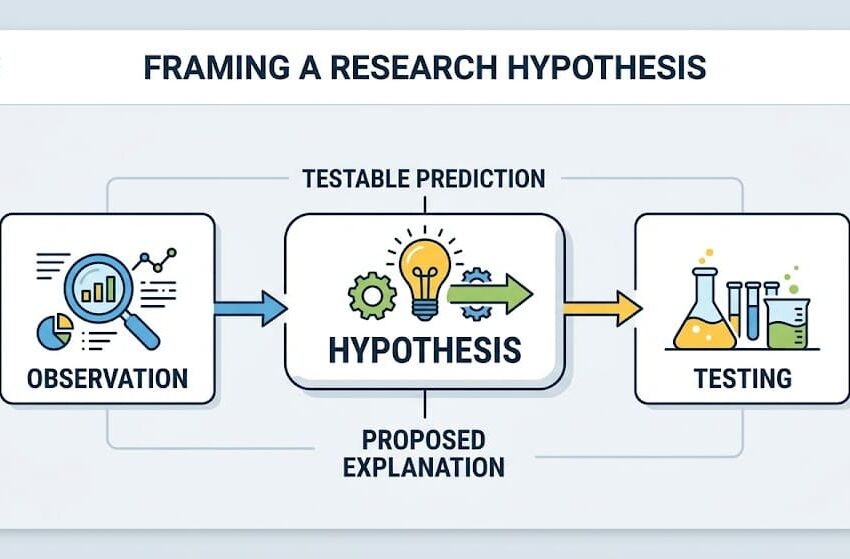
A strong research hypothesis gives your academic project a clear direction. It turns an idea about a subject into a specific prediction that can be examined through research, observation, or data analysis. Whether you are preparing a university research proposal, writing a dissertation, or conducting a scientific experiment, developing a suitable hypothesis helps you decide what evidence to collect and how to evaluate your findings.
Many students find it difficult to move from a broad topic to a precise prediction. A statement such as “technology improves education” sounds reasonable, but it does not identify which technology, which aspect of education, or what evidence would support the claim.
If you want to learn how to develop a research hypothesis, this guide explains the process step by step. You will discover what makes a hypothesis testable, learn the main types of hypotheses, explore examples from different academic fields, and review common mistakes to avoid.
What Is a Research Hypothesis?
A research hypothesis is a clear, testable prediction about an expected relationship, difference, or outcome. It is usually developed from a research question, preliminary reading, existing theories, and previous findings.
For example, a student investigating study habits might propose:
University students who use active recall regularly will achieve higher scores on a course knowledge test than students who rely primarily on rereading their notes.
This hypothesis identifies a group, a study strategy, and an expected difference in performance. The researcher can then design a study to investigate whether the evidence supports the prediction.
A hypothesis is not simply a guess. It should have a reasonable basis in existing knowledge and be specific enough that evidence could contradict it.
Not every research project requires a formal hypothesis. Exploratory and qualitative studies often begin with open research questions because their purpose is to understand experiences, meanings, or processes rather than test a predetermined prediction.
Why Is a Research Hypothesis Important?
A well-developed hypothesis helps organize several parts of the research process.
- It establishes a clear prediction. You know what relationship, difference, or outcome you intend to investigate.
- It guides research design. The hypothesis helps determine which variables, observations, or measurements are relevant.
- It supports focused data collection. You can prioritize evidence that directly addresses the proposed relationship.
- It informs data analysis. In quantitative studies, the hypothesis can help determine which statistical approach is appropriate.
- It makes the reasoning transparent. Readers can understand what you expected to find and compare that prediction with the actual results.
A hypothesis also makes it easier to recognize when a project is too broad. If you cannot identify the variables or evidence needed to examine your prediction, you may need to refine the research question first.
How to Develop a Research Hypothesis Step by Step
Step 1: Start With a Research Topic
Choose a topic that fits your academic subject and interests you enough to sustain your research. Your topic might concern education, psychology, environmental science, business, health, or another field.
For example, “student learning” is a broad topic. You could narrow it to “the relationship between revision strategies and examination performance among first-year university students.”
Before developing a hypothesis, consider whether relevant research exists, whether the topic is appropriate for your assignment, and whether you can access the evidence needed to investigate it.
Step 2: Conduct Preliminary Research
Read relevant academic publications before deciding what you expect to find. A hypothesis should be informed by evidence, not merely by personal opinion.
Look for:
- Findings from previous studies
- Theories that explain the phenomenon
- Relationships that researchers have already investigated
- Contradictions or limitations in existing research
- Questions that remain unanswered
For instance, if you are interested in revision strategies, you might examine research on active recall, spaced practice, rereading, and academic performance.
This preliminary review helps you develop a reasoned prediction and avoid repeating an assumption that has already been thoroughly examined without adding a useful new angle.
Step 3: Identify the Research Problem
A research problem describes the issue or uncertainty your study aims to address. It provides the reason for investigating the topic.
Consider this example:
Topic: Revision strategies and academic performance.
Research problem: Students use different revision strategies, but a researcher wants to examine whether the use of active recall is associated with differences in knowledge-test performance in a particular university course.
This problem is more focused than the general statement that study habits influence learning. It identifies a relationship that can be investigated using suitable evidence.
Your research problem should be supported by preliminary reading and aligned with the requirements of your project.
Step 4: Write a Focused Research Question
A research question asks what you want to discover. A hypothesis states what you predict the evidence will show.
For example:
Research question: Is regular use of active recall associated with higher knowledge-test scores among first-year university students?
Possible hypothesis: First-year university students who use active recall regularly will achieve higher knowledge-test scores than students who use it infrequently.
The question and hypothesis address the same issue, but they serve different purposes. The question identifies what will be investigated; the hypothesis states the expected result.
Make sure your question is clear enough to guide a research design. If it is too broad, refine it before writing the hypothesis.
Step 5: Identify the Key Variables
In many quantitative studies, a hypothesis predicts a relationship between two or more variables.
An independent variable is a factor that is manipulated or used as a predictor in the study. A dependent variable is the outcome being measured. The exact interpretation depends on the research design, and not every study involves experimental manipulation.
In the active-recall example:
- Population: First-year university students.
- Predictor: Frequency of active-recall use.
- Outcome: Knowledge-test score.
- Expected relationship: More frequent use is associated with higher scores.
You must also decide how each variable will be measured. For example, active-recall use might be recorded through a study diary or questionnaire, while test performance might be measured using a defined assessment.
Clear operational definitions help make your hypothesis testable and reduce ambiguity.
Step 6: Predict the Expected Relationship
Now state what you expect to find, based on the literature and your research question.
A hypothesis might predict:
- A positive relationship between two variables
- A negative relationship between two variables
- A difference between two groups
- An effect of an intervention under specified conditions
- No relationship or no difference, when that is the prediction being tested
For example:
Among first-year university students, greater weekly use of active-recall strategies will be associated with higher scores on a course knowledge test.
This statement is more precise than “active recall helps students.” It identifies a population, a predictor, an outcome, and a direction.
Be careful with causal language. If your study only observes students’ existing habits, it may show an association but cannot necessarily establish that active recall caused a change in scores.
Step 7: Make the Hypothesis Testable
A strong hypothesis can be evaluated using evidence that your study can realistically obtain.
Ask yourself:
- Can I observe or measure the variables?
- Can I identify what evidence would support or contradict the prediction?
- Is the population or setting sufficiently clear?
- Does the proposed method fit the hypothesis?
- Can I investigate the claim within the available time and resources?
Avoid vague statements such as “technology makes learning better.” Terms such as better, effective, and successful need clear definitions.
A more testable version could be:
Students who complete weekly online practice quizzes will achieve higher scores on a specified end-of-unit assessment than students who do not complete the quizzes, under the conditions of the proposed study.
The actual design would still need to explain how groups are selected, how scores are measured, and how other relevant factors are handled.
Step 8: Choose the Appropriate Type of Hypothesis
Once your prediction is clear, determine which form best fits the research.
A directional hypothesis predicts the direction of a relationship or difference. A non-directional hypothesis predicts a relationship or difference without specifying its direction.
For example:
- Directional: Students who use active recall regularly will achieve higher knowledge-test scores than students who rarely use it.
- Non-directional: Knowledge-test scores will differ between students who use active recall regularly and students who rarely use it.
Choose the directional form only when theory or previous evidence gives you a reasonable basis for predicting that direction. Do not choose it simply because a stronger-sounding statement seems more convincing.
Step 9: Review and Refine the Wording
Read your hypothesis carefully and remove unnecessary wording. A good hypothesis should communicate one main prediction rather than combine several unrelated claims.
Check that the statement:
- Uses precise, understandable language
- Identifies the relevant variables or conditions
- Specifies a population or context where necessary
- Reflects the evidence that informed the prediction
- Can be evaluated with the proposed research design
- Avoids claims that go beyond what the study can establish
Ask a supervisor or research adviser to review the wording if you are uncertain whether the hypothesis matches your methodology.
Types of Research Hypotheses With Examples
Different types of hypotheses serve different research purposes. The terminology can vary across disciplines, so follow the definitions used in your course.
1. Simple hypothesis
A simple hypothesis describes an expected relationship between one predictor and one outcome.
Example: Students who complete weekly practice quizzes will achieve higher scores on a course knowledge test.
This example predicts a relationship between practice-quiz participation and test performance.
2. Complex hypothesis
A complex hypothesis involves multiple predictors, outcomes, or relationships.
Example: Students who use active recall and spaced practice regularly will report greater confidence in course material and achieve higher knowledge-test scores than students who rely mainly on rereading.
This statement includes more than one study strategy and more than one outcome. For a real project, it may be better to separate these predictions into distinct hypotheses so each can be tested clearly.
3. Null hypothesis
A null hypothesis, often represented as (H_0), generally states that there is no specified relationship, difference, or effect in the population under the statistical model being tested.
Example:
(H_0): There is no difference in mean knowledge-test scores between students who regularly use active recall and students who rarely use it.
The null hypothesis provides a reference for statistical testing. A study that fails to reject the null hypothesis does not prove that the groups are identical; the result may also reflect uncertainty, limited sample size, measurement limitations, or other factors.
4. Alternative hypothesis
The alternative hypothesis, often represented as (H_1) or (H_a), expresses a relationship, difference, or effect that contrasts with the null hypothesis.
Example:
(H_1): Mean knowledge-test scores differ between students who regularly use active recall and students who rarely use it.
A directional alternative could predict that the first group has higher scores. The appropriate form depends on the research question and the planned statistical test.
5. Directional hypothesis
A directional hypothesis predicts which way a relationship or difference is expected to occur.
Example: Greater weekly physical-activity frequency will be associated with lower self-reported stress scores among university students.
This is a prediction, not a guaranteed result. The study must collect suitable evidence before drawing conclusions.
6. Non-directional hypothesis
A non-directional hypothesis predicts a relationship or difference but does not specify its direction.
Example: Self-reported stress scores will differ between university students with different levels of weekly physical activity.
This form is useful when prior evidence does not justify a confident prediction about the direction of the result.
7. Associative hypothesis
An associative hypothesis predicts that variables are related, without necessarily claiming that one causes the other.
Example: Weekly study time will be associated with examination scores among first-year university students.
If the study is observational, other factors may help explain the association. The wording should not imply causation without an appropriate design and supporting evidence.
8. Causal hypothesis
A causal hypothesis predicts that a change in one factor produces a change in an outcome. Such claims require a research design capable of supporting causal inference.
Example: Students assigned to a structured practice-quiz intervention will achieve higher scores on a subsequent knowledge test than students assigned to a comparison condition.
This example describes a possible experimental prediction. The strength of any causal conclusion would depend on the actual design, implementation, measurements, and analysis.
Research Hypothesis Examples From Different Fields
The following examples illustrate how a broad interest can be turned into a testable prediction. They are hypothetical and should not be interpreted as established research findings.
| Field | Research question | Example hypothesis |
|---|---|---|
| Education | Is active recall associated with test performance? | Students who use active recall more frequently will achieve higher knowledge-test scores. |
| Psychology | Is bedtime social-media use associated with sleep duration? | Greater social-media use before bedtime will be associated with shorter self-reported sleep duration. |
| Business | Is response time related to customer satisfaction? | Customers who receive faster responses to support requests will report higher satisfaction scores. |
| Environmental science | Does shade affect soil moisture? | Shaded plots will retain more soil moisture than comparable exposed plots under the specified conditions. |
| Health research | Is regular physical activity associated with perceived stress? | Higher levels of weekly physical activity will be associated with lower perceived-stress scores. |
| Technology | Does interface design influence task completion? | Participants using the simplified interface will complete the specified task in less time than participants using the original interface. |
Notice that each hypothesis identifies a relationship or difference that could be examined through appropriate observations or measurements. The methods would still need to define the population, variables, comparison conditions, and analysis.
Research Question vs. Research Hypothesis
A research question and a hypothesis are closely related, but they are not interchangeable.
| Research question | Research hypothesis |
|---|---|
| Asks what the study seeks to discover | Predicts what the evidence may show |
| Is usually phrased as a question | Is usually phrased as a declarative statement |
| Can guide qualitative, quantitative, or exploratory research | Is especially common in predictive and quantitative research |
| Does not require a predetermined prediction | States an expected relationship, difference, or outcome |
For example, “Is weekly study time associated with examination performance?” is a research question.
“Students who study for more hours each week will tend to achieve higher examination scores” is a possible hypothesis.
Some projects use both. Others rely on research questions because their purpose is exploratory or descriptive.
Common Mistakes to Avoid When Developing a Hypothesis
Writing a vague statement
A statement such as “education affects success” does not specify the variables, population, or meaning of success. Define the outcome and the relationship you want to investigate.
Treating an opinion as a hypothesis
A personal belief is not a sufficient research basis. Develop your prediction through preliminary research, relevant theory, and a clearly defined research problem.
Making the hypothesis too broad
Trying to predict many outcomes in one sentence can make the project difficult to test. Separate distinct predictions when necessary and ensure each one matches a research objective.
Ignoring how variables will be measured
A hypothesis may sound precise but remain difficult to test if terms such as engagement, performance, or well-being are not defined. Explain how each key concept will be observed or measured.
Confusing association with causation
Two variables may be related because of other factors. Avoid stating that one variable causes another unless your study design and evidence can support that claim.
Changing the hypothesis to fit the results
Exploring unexpected findings can be valuable, but distinguish exploratory analyses from predictions specified before data collection. Transparently report any changes rather than presenting a new prediction as if it had been planned from the beginning.
Assuming a hypothesis must be confirmed
A study can be valuable even when the evidence does not support the original prediction. The goal is to investigate the question rigorously, not to force the findings to match expectations.
Research Hypothesis Checklist
Before finalizing your hypothesis, check the following:
- It addresses a clear research question.
- It is based on relevant background reading or theory.
- It identifies the key variables or conditions.
- Its central concepts can be observed or measured.
- It predicts a relationship, difference, or outcome.
- The research design can evaluate the prediction.
- The wording is specific and unambiguous.
- It does not make unsupported causal claims.
- It fits the project’s scope, resources, and objectives.
- It follows the requirements of my discipline or supervisor.
If your hypothesis does not meet these criteria, revise it before moving on to the detailed research design.
Frequently Asked Questions
What makes a good research hypothesis?
A good research hypothesis is clear, specific, testable, and grounded in relevant evidence or theory. It predicts a relationship, difference, or outcome that the proposed research can investigate.
Can I write a hypothesis without a research question?
It is usually better to begin with a focused research question. The question defines what you want to investigate, while the hypothesis states what you expect to find. Starting with the question helps ensure that the prediction addresses the actual research problem.
Does every research project need a hypothesis?
No. Many quantitative studies use hypotheses, but exploratory, descriptive, and qualitative projects may be guided by research questions instead. The choice depends on the research purpose, discipline, and methodology.
How many hypotheses should a research project have?
There is no universal number. Use enough hypotheses to address the main predictive objectives without creating unnecessary complexity. Each hypothesis should have a clear purpose and align with the research question, design, and planned analysis.
What is the difference between a null and an alternative hypothesis?
The null hypothesis typically specifies no relationship, difference, or effect under the model being tested. The alternative hypothesis specifies a contrasting relationship, difference, or effect. Statistical analysis evaluates the evidence against the null under the assumptions of the chosen method.
Can a hypothesis be wrong?
Yes. A hypothesis is a prediction that may or may not be supported by the evidence. If the results do not support it, report that outcome honestly and discuss possible explanations and limitations.
Should a hypothesis be directional or non-directional?
Use a directional hypothesis when theory or previous evidence justifies predicting the direction of the relationship or difference. Use a non-directional hypothesis when you expect a difference or relationship but cannot reasonably predict its direction. Follow your discipline’s conventions.
Can qualitative research use a hypothesis?
Some qualitative traditions use propositions or preliminary expectations, but many qualitative studies are guided primarily by open-ended research questions. Avoid forcing a formal statistical hypothesis onto a study designed to explore meanings or experiences.
Conclusion
Developing a research hypothesis requires more than writing down what you think will happen. Start with a focused topic, examine the existing literature, identify the research problem, and formulate a question that can be investigated using credible evidence.
Next, identify the relevant variables, define how they will be measured, and state a prediction that matches your research design. Review the wording carefully to ensure that it is clear, testable, and appropriately cautious about relationships and causation.
Remember that a hypothesis guides your investigation; it does not determine what the results must be. A well-developed hypothesis makes your research more focused, helps you plan appropriate methods, and gives readers a clear understanding of what your study aims to test.
Leave a Reply