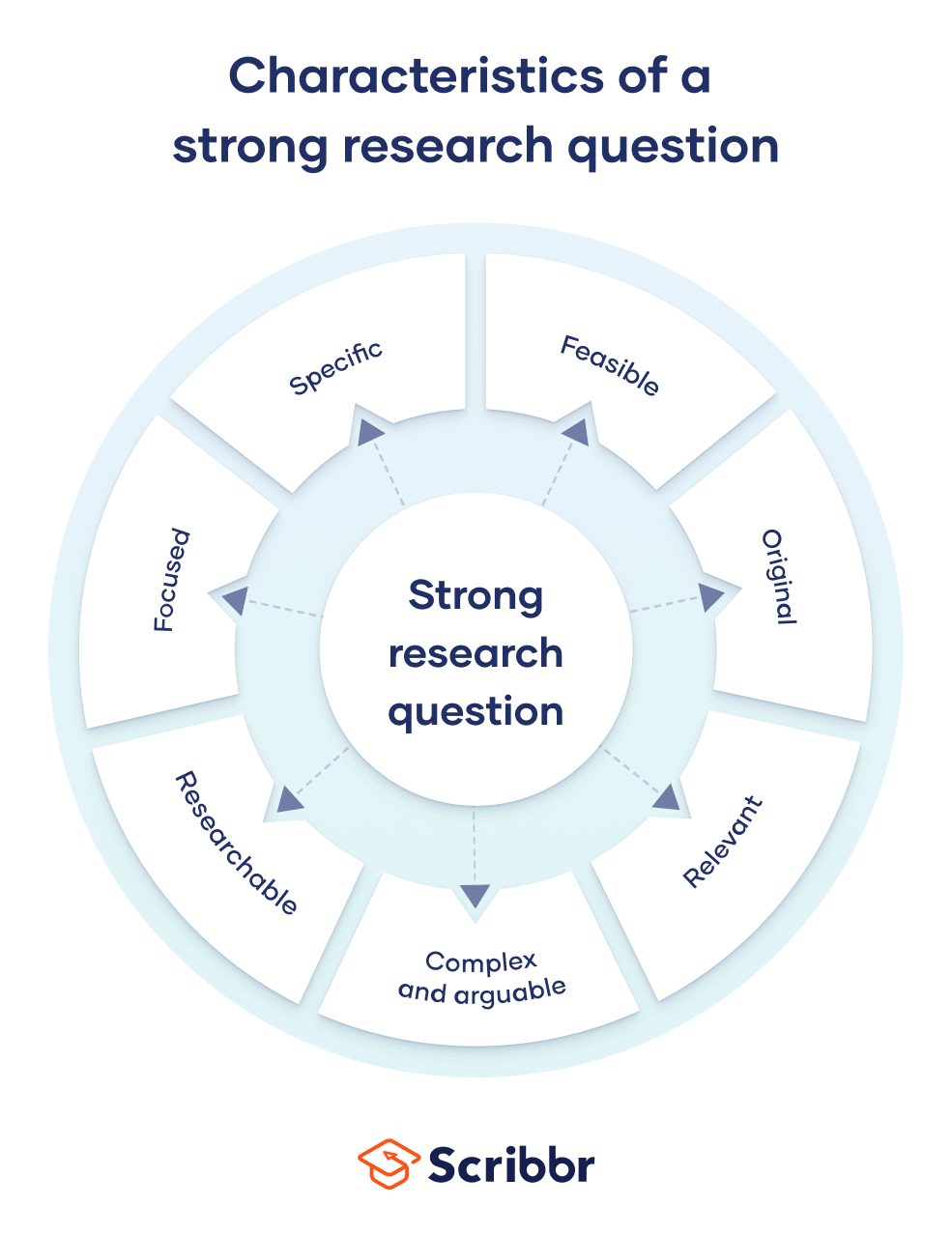
A strong research project begins with a clear research question. Whether you are writing a university essay, preparing a research proposal, conducting a dissertation, or planning a literature review, your question determines what you need to investigate and how you will approach the task.
Many students begin with a broad subject such as education, technology, climate change, or student well-being. Although these topics are useful starting points, they are usually too large to investigate effectively in one assignment. The key is to narrow the subject into a specific question that can be answered with available evidence.
If you want to learn how to develop a research question, this guide walks you through the process step by step. You will learn how to choose a topic, identify a research problem, narrow your focus, evaluate possible questions, and use practical examples to improve your final wording.
What Is a Research Question?
A research question is a focused question that defines what a study, essay, or research project aims to discover, explain, compare, or understand.
It provides direction for the rest of the research process. Once you have a clear question, you can identify relevant sources, choose suitable research methods, decide what information to collect, and organize your findings around a specific purpose.
For example, “online learning” is a broad topic, not a research question. A more focused question might be:
How do recorded lectures influence study flexibility among first-year university students?
This version identifies a particular feature of online learning, a group of students, and an outcome to investigate. It is much easier to turn into a manageable research project.
Why Is a Clear Research Question Important?
A well-developed question helps you make informed decisions throughout your research.
- It establishes focus. You know which information is relevant and which material falls outside the project’s scope.
- It guides your literature search. The key concepts in the question become useful search terms for finding books, articles, and reports.
- It informs your methodology. The wording helps you decide whether you need interviews, surveys, experiments, document analysis, or existing research.
- It makes your project manageable. A defined population, setting, or time period can keep the work within your deadline and word limit.
- It supports a coherent argument. Your introduction, evidence, analysis, and conclusion can all relate to the same central question.
University library guides emphasize that research questions help define the scope of a project and inform the search strategy and evidence required. <Cite refs={[“turn566197search1″,”turn566197search6″,”turn566197search9”]}/>
How to Develop a Research Question Step by Step
Step 1: Choose a Topic That Interests You
Start with a subject that connects to your course, professional goals, or genuine curiosity. An interesting topic can help sustain your motivation during reading, data collection, and writing.
Possible starting points include:
- The effects of digital tools on university learning
- Student experiences with online assessment
- Public attitudes toward renewable energy
- Reading habits among secondary school students
- The relationship between sleep and academic routines
At this stage, do not worry about writing the perfect question. Your goal is to identify a subject area worth exploring.
Consider whether the topic fits your assignment, whether credible information is available, and whether you can investigate it using the time and resources you have.
Step 2: Conduct Preliminary Research
Read introductory material and a few reliable sources before finalizing your question. Background reading helps you understand the terminology, major debates, and issues researchers have already examined.
Useful starting points include university library databases, scholarly journals, academic books, and reputable research organizations. Search engines such as can help you discover scholarly literature, but assess each source before relying on it.
During your initial reading, look for:
- Findings that researchers agree or disagree about
- Groups or settings that have received limited attention
- Limitations mentioned in existing studies
- Questions that remain unresolved
- Practical problems that deserve further investigation
You do not have to discover a completely untouched subject. For many undergraduate assignments, a focused comparison, a specific population, or a new context can provide a suitable research direction.
Step 3: Identify a Specific Research Problem
A topic describes the general area you want to study. A research problem explains the issue, uncertainty, or gap you want to investigate.
For example:
Broad topic: Digital learning in higher education.
Possible research problem: Students have access to recorded lectures, but you want to understand how they use these recordings when preparing for examinations.
Possible research question: How do first-year university students use recorded lectures when preparing for end-of-semester examinations?
The question now identifies a particular behavior and a defined group. It does not assume that recorded lectures automatically improve grades or that every student uses them in the same way.
Make sure the problem is relevant to your assignment and can be investigated using evidence you can realistically access.
Step 4: Narrow the Topic
Broad questions often produce too many possible answers. Narrowing the topic gives your research a manageable boundary.
You can refine a topic by specifying one or more of the following:
- Population: Who will you study?
- Concept or variable: What behavior, experience, factor, or outcome interests you?
- Setting: Where will the research take place?
- Time period: Is a particular period important?
- Comparison: Do you need to compare two groups, approaches, or conditions?
For example:
| Stage | Example |
|---|---|
| Broad topic | Social media and education |
| Narrower topic | Social media use and university study habits |
| More focused question | How do first-year university students describe the influence of social media notifications on their study routines? |
The final question points toward a manageable investigation. Its wording also suggests a qualitative approach because it asks how students describe their experiences. If you instead wanted to measure an association between notification frequency and study time, you would need a different question and potentially a quantitative method.
Step 5: Turn the Topic Into a Direct Question
Once you have a focused research problem, phrase it as a question that clearly states what you want to find out.
Useful question starters include:
- How — to explore processes, experiences, or relationships
- What — to identify characteristics, themes, or patterns
- Why — to investigate possible explanations, where evidence can support them
- To what extent — to assess degree, variation, or strength
- In what ways — to explore different forms or dimensions of a phenomenon
- What is the relationship between — to examine an association between variables
Choose wording that matches your intended research. Avoid questions that imply a conclusion before you have examined the evidence.
For example, instead of asking, “Why does online learning harm students?” use a more neutral question such as:
How do university students describe the benefits and challenges of online learning?
The revised wording allows the research to examine positive, negative, and mixed experiences.
Step 6: Check Whether the Question Is Researchable
A good research question must be answerable through evidence, not simply interesting to discuss.
Ask yourself:
- Can I find relevant academic literature or collect suitable data?
- Can I access the participants, documents, or other evidence I need?
- Are the key terms clear enough to investigate?
- Can I answer the question within my deadline and word limit?
- Does the question fit the requirements of my course or research project?
If the answer is no, revise the question. You might need to narrow the population, choose a more accessible data source, or focus on one part of the problem.
For a systematic review, you may also need to define eligibility criteria and choose a suitable question framework. University guidance recommends testing a question against the evidence available and refining it as you learn more about the topic. <Cite refs={[“turn566197search2″,”turn566197search4″,”turn566197search5”]}/>
Step 7: Choose a Suitable Research Approach
Your research question should fit the type of evidence you intend to use.
Qualitative research is useful for exploring experiences, perceptions, interpretations, and processes. For example: How do first-year students describe their experiences of receiving feedback on online assignments?
Quantitative research focuses on measurements, patterns, differences, or relationships between variables. For example: Is the frequency of recorded-lecture use associated with examination scores among first-year students?
Mixed-methods research combines quantitative and qualitative approaches when both numerical patterns and personal explanations are important.
Literature-based research examines existing publications rather than necessarily collecting new data. For example: What challenges to student engagement are reported in studies of online learning in higher education?
These categories are broad guides rather than rigid rules. Choose a method based on your question, assignment requirements, ethical considerations, and available resources.
Step 8: Refine and Test the Final Wording
Your first version does not have to be final. Test it by reading it aloud and checking whether it identifies a clear research purpose.
Look for vague words such as “good,” “bad,” “effective,” and “impact” when they are not defined. Ask what you would actually measure, observe, compare, or analyze.
For example:
Initial question: Is technology good for education?
Refined question: How do interactive online quizzes influence weekly revision habits among first-year university students?
The refined version specifies a type of technology, an outcome, and a population. Depending on your project, you may still need to define the setting or clarify how revision habits will be measured.
Finally, conduct a small exploratory search. If you find too little relevant research, broaden the question slightly. If the search returns an overwhelming amount of material, narrow the scope further.
Frameworks That Can Help You Develop a Research Question
For some projects, a framework can help you organize the main elements of a question. You do not need one for every assignment; use a framework when it clarifies the problem rather than forcing your topic into an unsuitable structure.
PICO: For focused intervention questions
PICO is commonly used in health and evidence-based research:
- P — Population or problem
- I — Intervention
- C — Comparison
- O — Outcome
An illustrative question is: Among first-year university students, does a weekly retrieval-practice quiz, compared with rereading notes, improve performance on a course knowledge test?
The framework makes the population, intervention, comparison, and outcome explicit.
PICo: For questions about experiences or context
PICo can help structure qualitative or scoping questions:
- P — Population
- I — Interest or phenomenon of interest
- Co — Context
An example is: How do first-year university students experience peer feedback in online writing courses?
The framework helps identify the group, experience, and learning context.
SPIDER: For qualitative and mixed-methods evidence
SPIDER stands for Sample, Phenomenon of Interest, Design, Evaluation, and Research type. It can be useful when planning a qualitative or mixed-methods literature search.
For example, a review might explore how university students experience collaborative online learning and which qualitative studies describe those experiences.
Frameworks should fit the purpose of the research. University College London provides an overview of frameworks and explains how they can help define concepts and guide systematic searching. <Cite refs={[“turn566197search0″,”turn566197search3″,”turn566197search4”]}/>
Common Research Question Mistakes to Avoid
Making the question too broad
A question covering all students, all learning methods, and all academic outcomes is likely to be unmanageable. Define the group, context, or outcome you want to examine.
Making the question too narrow
A highly specific question may leave you with too little evidence or an unrealistic data-collection task. Check the available literature and resources before settling on the final scope.
Asking a question that can only be answered with yes or no
Closed questions are not always inappropriate, particularly in some experimental designs. However, a question such as “Does online learning work?” is usually too vague for a substantial academic project. Specify what “work” means and under which conditions.
Assuming the answer in advance
Questions that describe a method as “harmful,” “best,” or “ineffective” may introduce bias before the research begins. Use neutral language unless you are explicitly testing a well-defined claim.
Confusing a topic with a research question
“Climate change and agriculture” names a subject. A question such as “How have changing rainfall patterns affected crop choices among small-scale farmers in a specified region?” identifies something to investigate.
Ignoring practical limitations
A question may sound compelling but require inaccessible records, expensive equipment, or participants you cannot recruit. Adapt the scope to your actual resources and any ethical approval requirements.
Final Research Question Checklist
Before approving your question, check the following:
- It is clearly worded and easy to understand.
- It identifies a specific issue or relationship.
- Its key terms can be defined.
- It can be answered using credible evidence.
- Its scope fits my deadline and assignment length.
- It does not assume a particular result.
- It aligns with a realistic research approach.
- Preliminary reading suggests that the question is relevant and worth investigating.
- It meets my instructor’s or supervisor’s requirements.
If the question fails one or more checks, revise it before moving on to a detailed literature review or data collection plan.
Frequently Asked Questions
What makes a good research question?
A good research question is clear, focused, relevant, and answerable using suitable evidence. It establishes a manageable scope, uses precise terms, and matches the purpose and methods of the project.
How do I narrow a broad research topic?
Start by identifying the particular problem or aspect that interests you. Then define the population, context, concept, outcome, or comparison you want to examine. Review relevant literature to confirm that the refined topic is both meaningful and researchable.
Can a research question change during a project?
Yes. Research questions often develop as you read more, discover new evidence, or encounter practical constraints. Refinements should improve clarity and feasibility while remaining consistent with assignment requirements and any approved research protocol.
What is the difference between a research question and a hypothesis?
A research question asks what a study aims to investigate. A hypothesis is a specific, testable prediction about an expected result or relationship. Some quantitative studies test hypotheses, while exploratory and qualitative projects may be guided primarily by research questions.
How many research questions should a project have?
The number depends on the project’s scale and instructions. A short essay may need only one central question, while a dissertation or complex study may include several related sub-questions. Keep the scope coherent so that every question can be addressed adequately.
Should a research question be written before or after the literature review?
Begin with a provisional question before conducting detailed research. Then use preliminary reading to refine it. For larger projects, the question may continue to evolve as you assess the existing evidence, clarify the research gap, and finalize your method.
Conclusion
Developing a clear research question is one of the most important steps in academic research. Start with a topic that interests you, conduct preliminary reading, identify a specific problem, and narrow the scope until you have a question that is focused and answerable.
Test the wording against the available evidence, your intended research method, and the time and resources you have. Use a framework when it helps clarify the key concepts, but prioritize a question that genuinely fits your research purpose.
A well-developed question gives your literature search direction, supports sensible methodological decisions, and keeps your final paper focused. Spend time refining it before moving forward: the clearer your question, the easier it becomes to plan and complete the rest of your research.
Leave a Reply