Blog

  • How to Paraphrase Academic Sources Correctly

    How to Paraphrase Academic Sources Correctly

    Paraphrasing is an essential academic writing skill. It allows you to use information from books, journal articles, research reports, and other credible sources while developing your own explanation and argument. When done correctly, paraphrasing shows that you understand the material rather than simply copying the author’s wording.

    However, many students find it difficult to restate research without changing its meaning or staying too close to the original text. Replacing a few words with synonyms is not enough, and paraphrased ideas still require citations.

    If you want to learn how to paraphrase academic sources, this guide explains the process step by step. You will learn how to identify key ideas, rewrite them accurately, cite sources correctly, compare weak and strong examples, and avoid common paraphrasing mistakes.

    What Is Academic Paraphrasing?

    Academic paraphrasing means expressing another author’s idea or passage in your own words and sentence structure while preserving its original meaning. It allows you to incorporate research naturally into your writing without relying too heavily on direct quotations.

    A successful paraphrase should:

    • Preserve the original author’s main point and intended meaning.
    • Use your own vocabulary and sentence structure.
    • Represent the evidence and conclusions accurately.
    • Include an appropriate citation.
    • Fit naturally into your own discussion or argument.

    Paraphrasing does not mean changing the author’s conclusion to support your opinion. It also does not mean disguising copied text by changing a few words. The goal is to communicate the source’s meaning accurately in a form that fits your own academic work.

    Purdue University’s Online Writing Lab explains that paraphrased information must be documented, just like directly quoted material. <Cite refs={[“turn348240search0″,”turn348240search4”]}/>

    Why Is Paraphrasing Important in Academic Writing?

    Paraphrasing helps you use research effectively while maintaining a clear and original writing style.

    It demonstrates understanding

    When you can explain a research finding in your own words, you show that you have understood its meaning. Simply copying a sentence does not necessarily demonstrate the same level of comprehension.

    It reduces unnecessary quotations

    Direct quotations are useful when an author’s exact wording matters. However, using too many quotations can make an essay feel disconnected. Paraphrasing allows you to explain ideas in a consistent voice while still crediting the original researcher.

    It helps develop your argument

    Academic assignments usually require more than collecting information. You must connect evidence to your thesis, compare viewpoints, and explain why the findings matter. Paraphrasing makes it easier to integrate research into that discussion.

    It supports academic integrity

    Giving credit for borrowed ideas acknowledges the original author’s contribution. Correct paraphrasing and citation practices also reduce the risk of accidental plagiarism. <Cite refs={[“turn348240search2″,”turn348240search8”]}/>

    How to Paraphrase Academic Sources Step by Step

    Use the following method whenever you need to incorporate a source into an essay, literature review, dissertation, or research paper.

    Step 1: Read the Original Passage Carefully

    Read the passage more than once if necessary. Before rewriting it, identify the author’s main claim, supporting evidence, and intended meaning.

    Pay attention to qualifications and limitations. For example, a study may report that a strategy may improve student performance under certain conditions. Rewriting that claim as “the strategy always improves performance” would exaggerate the evidence.

    Ask yourself:

    • What is the author actually claiming?
    • What evidence supports the claim?
    • Are there conditions or limitations?
    • Which details are essential for my discussion?

    Do not begin rewriting until you can explain the passage without looking at it.

    Step 2: Identify the Main Idea You Need

    You rarely need to reproduce every detail in a source. Select the information that directly supports your research question or paragraph.

    Suppose you are writing about digital learning tools. An article might discuss student participation, teacher training, device access, software design, and assessment. If your paragraph focuses on student participation, you may need only the findings relevant to that subject.

    Selecting the right information helps you create a focused paraphrase rather than rewriting an entire section unnecessarily.

    Step 3: Set the Source Aside

    After understanding the passage, look away from the original text and write the idea from memory using your own wording.

    This technique reduces the temptation to follow the source sentence by sentence. It also encourages you to reorganize the explanation around the point you want to make.

    Your notes should record the source details separately so that you can cite the original author accurately later.

    Step 4: Rewrite the Idea in Your Own Words and Structure

    Change more than individual vocabulary items. Rebuild the sentence around the meaning you want to communicate.

    You may need to:

    • Change the sentence structure.
    • Combine related points or divide a complicated sentence.
    • Use a different grammatical form.
    • Remove unnecessary wording.
    • Explain a technical idea more clearly without losing precision.

    Keep important technical terms when they have a specific meaning in the subject area. Not every word needs a synonym, and forcing unusual alternatives can make academic writing less accurate.

    University writing guidance recommends changing both wording and structure while preserving the source’s meaning. <Cite refs={[“turn348240search8″,”turn348240search11”]}/>

    Step 5: Compare Your Version With the Original

    Return to the original passage and check your paraphrase carefully. Confirm that you have not changed the author’s claim, omitted an important qualification, or introduced a conclusion that the source does not support.

    Look for phrases that remain identical to the source. If you have retained distinctive wording, place it in quotation marks and cite it appropriately, or rewrite the passage more substantially.

    There is no universal number of changed words that automatically makes a paraphrase acceptable. The key issues are whether the language and structure are genuinely your own, whether the meaning is accurate, and whether the source is credited.

    Step 6: Add the Correct Citation

    A paraphrase still uses someone else’s ideas, so it requires a citation even when none of the original wording remains.

    Citation requirements depend on the style your institution uses. For example, APA and MLA handle in-text citations differently. A page or paragraph number may not always be mandatory for a paraphrase, but it can help readers locate a specific passage and may be required by your instructor.

    Always verify the rules for the required citation style rather than guessing.

    Step 7: Connect the Paraphrase to Your Argument

    Do not insert a paraphrase without explaining why it matters. Introduce the source where useful, state the relevant finding, and connect it to your point.

    For example, after paraphrasing a study about online learning, explain whether the findings support your claim, differ from other research, or reveal a limitation.

    This final step turns borrowed information into part of a coherent academic discussion rather than a collection of disconnected facts.

    Paraphrasing Examples: Weak vs. Strong

    The following examples are original illustrations created for this guide, not quotations from published research.

    Example 1: Changing only a few words

    Illustrative original sentence:

    “Regular feedback helps students identify weaknesses in their work and make improvements before the final assessment.”

    Weak paraphrase:

    “Frequent feedback assists students in finding weaknesses in their work and making improvements before the final evaluation.”

    This version changes several words but closely follows the original sentence structure and wording. A synonym swap alone is not a reliable paraphrasing method.

    Stronger paraphrase:

    “Students can use comments received during the learning process to recognize areas that need attention and revise their work before it is graded.”

    This version reorganizes the idea and uses a different sentence structure while preserving the central meaning. If this claim came from a real source, it would still need an appropriate citation.

    Example 2: Preserving the limits of a research finding

    Illustrative original sentence:

    “The results suggest that short classroom quizzes may improve retention when students receive timely feedback.”

    Inaccurate paraphrase:

    “Short quizzes improve learning in every classroom.”

    This statement removes the uncertainty in “may,” broadens the finding beyond the original conditions, and changes retention into a much wider claim about learning.

    Stronger paraphrase:

    “The findings indicate that brief classroom quizzes could help students remember material, particularly when feedback is provided promptly.”

    The revised version changes the wording while retaining the original claim’s cautious tone and important condition.

    Example 3: Paraphrasing a research finding in a paragraph

    Imagine that a published study reports an association between regular reading practice and vocabulary development.

    A paraphrase might explain that students who read consistently may encounter more words in context, helping them become familiar with vocabulary over time. The writer should then cite the study and avoid claiming that reading alone guarantees vocabulary improvement unless the evidence supports that conclusion.

    This approach summarizes the relevant finding, uses new wording, preserves appropriate caution, and attributes the idea to its source.

    How to Cite Paraphrased Academic Sources

    Citation is part of paraphrasing, not an optional step added only when you use the author’s exact words.

    APA style

    APA in-text citations generally include the author’s surname and publication year. A page number is optional for many paraphrases but can be useful when referring to a specific passage.

    Illustrative format:

    Research suggests that timely feedback can help students identify areas for improvement (Taylor, 2024).

    The name and year above are examples only. Replace them with the details of your real source.

    MLA style

    MLA in-text citations commonly include the author’s surname and a page number when one is available.

    Illustrative format:

    Timely feedback can help learners identify problems and revise their work (Taylor 42).

    This is a format illustration, not a reference to a real publication.

    Chicago style

    Chicago offers different documentation systems, including notes and bibliography and author-date. Follow the system required by your course or publication.

    For all styles, make sure the in-text citation corresponds to a complete entry in the reference list or bibliography. Consult the official guide or your university library if you are uncertain about punctuation, page numbers, or source types.

    Common Paraphrasing Mistakes to Avoid

    1. Replacing words with synonyms

    Changing only a handful of words while retaining the original structure can result in patchwriting. Rebuild the sentence around the meaning instead of treating the original as a template.

    2. Forgetting the citation

    Paraphrasing changes the wording, not the ownership of the idea. Cite the source whenever you use its specific claims, findings, or reasoning.

    3. Changing the original meaning

    Do not turn a possible relationship into a proven cause, remove an important limitation, or make a cautious conclusion sound certain. Represent the source fairly.

    4. Keeping distinctive phrases without quotation marks

    Some technical terms cannot easily be replaced, and ordinary subject terminology may remain unchanged. However, distinctive wording borrowed directly from a source should be quoted and documented as required.

    5. Paraphrasing without understanding

    If you do not understand the passage, you may produce inaccurate or confusing writing. Read the surrounding section and consult other reliable explanations when necessary.

    6. Using automated rewriting tools without checking the result

    Writing tools can suggest alternative phrasing, but they may distort meaning, invent details, or produce wording that remains too close to the source. You remain responsible for accuracy, originality, and proper attribution. Check your institution’s rules on permitted AI assistance.

    7. Treating a plagiarism checker as proof of originality

    Similarity reports can help identify text that deserves review, but a score alone cannot determine whether writing is academically acceptable. Proper quotation, citation, context, and source use still require human judgment.

    A Quick Checklist for Correct Paraphrasing

    Before submitting your assignment, ask yourself:

    • Have I understood the original passage and its context?
    • Have I selected only the information relevant to my argument?
    • Have I written the idea in my own words and sentence structure?
    • Have I preserved the author’s meaning, evidence, and qualifications?
    • Have I placed quotation marks around any distinctive wording retained exactly?
    • Have I cited the original source using the required style?
    • Have I connected the paraphrase to my own discussion?
    • Have I checked the final wording against the original for accuracy?

    If you cannot confidently answer yes to each relevant question, revise the passage before submitting your work.

    Frequently Asked Questions

    How do you paraphrase academic sources without plagiarizing?

    Understand the source, set it aside, express the idea in your own wording and sentence structure, compare your version with the original, and cite the author. If you retain distinctive wording, use quotation marks and follow the required citation rules.

    Do I need to cite a paraphrase?

    Yes. You must credit the source of borrowed ideas and information even when you have completely rewritten the sentence. Exact citation details depend on the style guide and your assignment requirements.

    How different does a paraphrase need to be from the original?

    There is no universal percentage or word-count rule that guarantees an acceptable paraphrase. The wording and sentence structure should reflect your own expression while accurately preserving the source’s meaning. Cite the source and quote any distinctive language you retain.

    Is paraphrasing the same as summarizing?

    No. A paraphrase restates a specific idea or passage in different wording and may be similar in length to the original. A summary condenses the main points of a larger passage, article, or work into a shorter overview. Both require attribution when they use another author’s ideas.

    Can I paraphrase a source that I found online?

    Yes, if the source is suitable for your academic task. Check its credibility and relevance, record the publication details, paraphrase accurately, and cite it using the required style. Online availability does not remove the need for attribution.

    Can AI tools help with academic paraphrasing?

    AI tools can assist with brainstorming or clarifying difficult language when their use is allowed. However, they may alter claims, introduce unsupported information, or fail to preserve the author’s intended meaning. Review every suggested version against the original, cite the source, and follow your institution’s academic integrity policy.

    Conclusion

    Learning how to paraphrase academic sources correctly can improve the clarity, credibility, and flow of your academic writing. The process begins with understanding the original idea, selecting the information you need, and rewriting it using your own vocabulary and sentence structure. You must then check the meaning, cite the source, and connect the information to your argument.

    Remember that good paraphrasing is not a word-swapping exercise. It is a careful process of understanding, accurate restatement, and attribution. With practice, you can integrate research more naturally, avoid common citation mistakes, and build stronger essays, literature reviews, and research papers.
  • How to Write an Annotated Bibliography Step by Step

    How to Write an Annotated Bibliography Step by Step

    Writing an annotated bibliography is an important part of academic research. It helps you organize sources, understand different perspectives, and decide which books, journal articles, and websites are most useful for your assignment. Unlike a standard reference list, an annotated bibliography includes a short paragraph after each citation that summarizes and evaluates the source.

    If you are learning how to write an annotated bibliography, the process becomes easier when you break it into manageable steps. You need to find reliable sources, cite them in the correct format, summarize their main ideas, assess their quality, and explain how each source supports your research topic.

    This guide explains each stage with practical examples, formatting tips, and a checklist you can use before submitting your work.

    What Is an Annotated Bibliography?

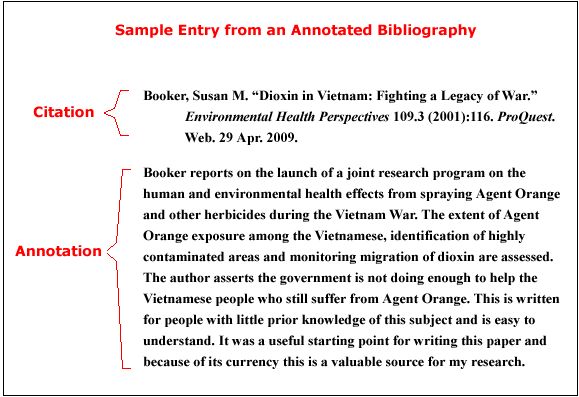
    An annotated bibliography is a list of research sources accompanied by explanatory notes called annotations. Each entry normally contains two parts:

    • Citation: The publication details of a book, academic article, report, or other source, formatted according to a required citation style.
    • Annotation: A paragraph that describes the source, evaluates its credibility, and explains its relevance to your research.

    For example, a student researching the effects of social media on academic performance might collect journal articles about study habits, sleep, concentration, and student achievement. The annotation under each citation would explain the article’s findings and how those findings contribute to the research question.

    Why Is an Annotated Bibliography Important?

    An annotated bibliography does more than demonstrate that you have collected references. It encourages you to engage critically with your research.

    It helps you evaluate sources. You consider whether the author is qualified, the evidence is reliable, and the publication is suitable for academic work.

    It organizes your research. Notes about each source make it easier to locate relevant evidence when you begin writing your essay or research paper.

    It reveals different perspectives. Comparing sources can help you identify disagreements, recurring themes, and unanswered questions.

    It supports a stronger argument. By identifying the most relevant evidence early, you can develop a focused thesis and avoid relying on sources that do not support your research goals.

    How to Write an Annotated Bibliography Step by Step

    Follow these steps to create an organized, accurate, and useful annotated bibliography.

    Step 1: Understand the Assignment Requirements

    Before searching for sources, read your assignment instructions carefully. Confirm the required number of entries, permitted source types, citation style, annotation length, and submission format.

    Your instructor may request descriptive annotations, evaluative annotations, or a combination of both. A descriptive annotation mainly explains what a source covers. An evaluative annotation also assesses its reliability, strengths, limitations, and usefulness.

    Check these details before beginning:

    • How many sources must you include?
    • Must the sources be scholarly or peer-reviewed?
    • Should you use APA, MLA, Chicago, or another citation style?
    • Is there a required word count for each annotation?
    • Must the entries be arranged alphabetically or by topic?

    Following the assignment brief helps you avoid unnecessary work and formatting errors.

    Step 2: Define Your Research Topic

    A clear topic makes it easier to find relevant sources. If your subject is too broad, you may collect articles that cover unrelated issues. If it is too narrow, you may struggle to find enough useful research.

    For example, instead of researching “education,” narrow the subject to “the effects of digital learning tools on university students’ academic performance.”

    Turn the topic into a research question, such as:

    How do digital learning tools affect university students’ academic performance and engagement?

    Use the question to guide your searches. Include related terms and synonyms so that you do not miss useful research.

    Step 3: Find Reliable Academic Sources

    Search for materials that directly address your topic. Useful places to begin include university library databases, scholarly journals, academic books, and reputable government or research organization websites.

    You can also use  to discover academic publications. However, do not assume that every result is automatically reliable or suitable for your assignment.

    Evaluate potential sources by checking:

    • Author expertise: Does the author have relevant qualifications or research experience?
    • Publication quality: Is the source published by a reputable journal, university press, or organization?
    • Evidence: Does the work support its claims with data, references, or transparent reasoning?
    • Currency: Is the information recent enough for your topic?
    • Relevance: Does the source directly help answer your research question?

    Read beyond the title and abstract when possible. Review the methods, findings, conclusion, and limitations before deciding whether to include a source.

    Step 4: Record Complete Citation Details

    Save the bibliographic information as soon as you select a source. Waiting until the end can lead to missing publication dates, incorrect author names, or lost links.

    Depending on the source type and citation style, you may need:

    • Author or authors
    • Publication year or date
    • Title of the article or book
    • Journal or publisher name
    • Volume, issue, and page numbers
    • DOI or URL, where required

    Use a reference manager or a simple spreadsheet to organize these details. Tools can help you collect and format citations, but always verify their output against the required style guide.

    Step 5: Read and Take Focused Notes

    Read each source with your research question in mind. You do not need to record every detail. Instead, identify the information that will help you explain the source’s purpose and value.

    For each source, note:

    1. The central argument, purpose, or research question.
    2. The main findings or conclusions.
    3. The evidence or methods used.
    4. The author’s relevant expertise and the publication’s credibility.
    5. Any limitations, bias, or unanswered questions.
    6. How the source connects to your research topic.

    These notes provide the foundation for your annotation. They also help you distinguish between what the source actually says and your own evaluation of it.

    Step 6: Write the Annotation

    The annotation follows the citation and is usually written as a concise paragraph. Its length depends on your instructor’s requirements; many assignments ask for roughly 100–200 words, but some require more or less.

    A useful annotation often combines three elements:

    Summary: Explain the source’s main purpose, argument, methods, or findings.

    Evaluation: Assess its credibility, strengths, and limitations. Consider whether the evidence is convincing and whether the source is appropriate for your topic.

    Relevance: Explain how the source will contribute to your research. Does it support your argument, offer a contrasting perspective, provide background, or identify a research gap?

    Not every assignment requires all three elements. Follow your instructor’s directions and keep the paragraph focused on the source’s most important contribution.

    Step 7: Format the Bibliography Correctly

    Citation style affects how your entries look. APA, MLA, and Chicago have different conventions, so do not combine their rules.

    General formatting principles include:

    • Place each citation before its annotation.
    • Use the citation style specified in your assignment.
    • Apply the required spacing and margins consistently.
    • Use a hanging indent for citations when required by the selected style.
    • Indent annotations according to the relevant guide.
    • Arrange entries alphabetically by author unless your instructions specify another order.

    Step 8: Revise and Proofread

    After drafting all entries, review the bibliography as a complete document. Each annotation should be accurate, concise, and clearly connected to your research question.

    Check that every citation corresponds to the source you actually consulted. Confirm author names, dates, titles, page numbers, and DOI or URL details. Correct grammar, spelling, punctuation, and formatting inconsistencies.

    Finally, ask whether each source deserves its place in the bibliography. Remove irrelevant or weak sources and replace them with stronger alternatives when necessary.

    Annotated Bibliography Example

    The following is an illustrative example showing how an annotation can summarize, evaluate, and explain relevance. It is not a citation to a real publication.

    Illustrative citation

    Taylor, A. (2023). Digital learning tools and student engagement in higher education. Journal of Educational Research, 18(2), 45–60.

    Illustrative annotation

    This hypothetical article examines how digital learning tools may influence university students’ engagement with course materials. It discusses features such as interactive quizzes, online discussions, and recorded lectures, with a focus on participation and independent learning. The article would be useful if its research methods and evidence were clearly reported and appropriate for the research question. Before relying on it, a researcher should verify the publication, author credentials, and reported findings, as well as consider whether the study’s sample represents students in other institutions. This source could help explain how specific digital tools relate to student engagement and provide a basis for comparison with research on academic performance.

    Notice how the annotation does more than repeat a title. It describes the topic, considers credibility, identifies a potential limitation, and explains how the source could support a research project. In your own work, make every statement specific to the real source you have read.

    Common Mistakes to Avoid

    Even a well-researched bibliography can lose quality if its annotations are too vague or its citations are inaccurate.

    Only summarizing the source: A summary may be insufficient when your assignment requires evaluation. Explain why the source is credible and useful, where appropriate.

    Copying the abstract: An annotation should be written in your own words. Copying a publisher’s abstract without permission or proper attribution can create plagiarism concerns and usually fails to provide your own evaluation.

    Choosing sources that are not relevant: A publication may be credible but still have little value for your research question. Prioritize sources that directly contribute to your topic.

    Making unsupported judgments: Do not call a source biased, unreliable, or authoritative without explaining the evidence behind that assessment.

    Ignoring citation rules: Small inconsistencies in punctuation, italics, dates, or indentation can make the bibliography look careless. Use one required style consistently.

    Writing overly long annotations: Include the source’s most important points rather than describing every section. Follow the assigned word count.

    Final Annotated Bibliography Checklist

    Before submitting your assignment, use this checklist:

    • I followed the assignment instructions.
    • Every source is relevant to my research question.
    • I checked each source’s credibility and quality.
    • Every citation follows the required style.
    • Each annotation accurately summarizes the source.
    • I included evaluation and relevance where required.
    • I wrote the annotations in my own words.
    • I checked citation details, grammar, and spelling.
    • Formatting and entry order are consistent.

    Frequently Asked Questions

    How long should an annotated bibliography be?

    The length depends on the number of sources and the required annotation length. Some assignments request a short paragraph of around 100–150 words per source, while others require longer evaluations. Follow your instructor’s instructions rather than relying on a universal word count.

    What should an annotated bibliography include?

    Each entry generally includes a complete citation followed by an annotation. Depending on the assignment, the annotation may summarize the source, evaluate its credibility and limitations, explain its relevance, or combine all three elements.

    What is the difference between an annotated bibliography and a reference list?

    A standard reference list identifies the sources cited in a paper. An annotated bibliography adds a descriptive or evaluative paragraph to each citation, helping readers understand the source’s content and usefulness.

    Can I use websites in an annotated bibliography?

    Yes, if websites are allowed by the assignment and are suitable for the topic. Prefer authoritative sources such as university libraries, government agencies, and established research organizations. Evaluate the author’s expertise, evidence, purpose, and publication date before including a website.

    Should annotated bibliography entries be in alphabetical order?

    Alphabetical order by the first author’s surname is common, but it is not universal. Some assignments permit organization by topic, publication date, or another logical structure. Follow your instructor’s directions.

    Can citation generators write my annotated bibliography?

    Citation generators can help format reference details, but they do not reliably evaluate sources or explain their relevance to your research. Check generated citations for errors and write annotations based on your own reading and analysis.

    Conclusion

    Learning how to write an annotated bibliography is a practical way to strengthen your research and academic writing skills. Start by understanding the assignment, defining a focused topic, and finding reliable sources. Then record accurate citation details, write concise annotations, evaluate each source, and explain its relevance to your project.

    The most effective annotated bibliographies do more than list publications. They show that you have read critically, assessed the evidence, and selected sources that contribute meaningfully to your research. With careful organization and consistent formatting, you can create a bibliography that makes the next stage of academic writing easier.

  • evaluate-academic-research-sources/

    evaluate-academic-research-sources/

    Finding information for a research paper is easier than ever, but finding information you can trust takes careful judgment. Students can access academic journals, university websites, online reports, blogs, and social media posts within seconds. However, not every source is accurate, relevant, or suitable for academic work.

    Learning how to evaluate academic sources helps you distinguish reliable evidence from unsupported claims, recognize potential bias, and build stronger research papers. It also helps you avoid citing outdated information, misleading statistics, or publications that do not support your argument.

    This guide explains how to evaluate academic sources step by step, recognize credible research, verify information online, and decide whether a source belongs in your assignment.

    What Makes an Academic Source Credible?

    A credible academic source provides information that can be examined, verified, and assessed in context. It usually identifies its author or responsible organization, explains where its information comes from, and supports its conclusions with appropriate evidence.

    Examples of academic sources include:

    • Peer-reviewed journal articles.
    • Scholarly books published by reputable academic publishers.
    • Research reports from established institutions.
    • Conference papers relevant to your discipline.
    • Government or university research publications.
    • Systematic reviews and other evidence-based scholarly reviews.

    However, a source is not automatically reliable just because it appears in an academic journal or on a university website. You still need to examine its methodology, relevance, publication history, and potential limitations.

    Likewise, a source does not become unreliable simply because it is freely available online. Credibility depends on the quality of the evidence and the context in which the information is used.

    Why Is Evaluating Academic Sources Important?

    Source evaluation is a fundamental research skill because the quality of your evidence affects the strength of your conclusions.

    Carefully evaluating sources helps you:

    • Improve research accuracy: Identify claims supported by evidence rather than assumptions.
    • Avoid misinformation: Recognize misleading, incomplete, or outdated information.
    • Strengthen academic arguments: Support your points with appropriate research.
    • Identify bias: Understand how funding, affiliations, or publication goals may influence a source.
    • Save research time: Focus on sources that directly answer your research question.
    • Maintain academic integrity: Represent other researchers’ findings accurately and cite them correctly.

    A well-written paper depends not only on the number of sources you collect but also on how carefully you select and interpret them.

    1. Check the Author’s Qualifications and Expertise

    The first step in evaluating a source is to identify who created it and whether they have relevant expertise.

    Look for the author’s name, academic qualifications, institutional affiliation, professional experience, and previous publications. For specialized subjects, such as medicine, engineering, or education research, relevant subject knowledge matters more than general popularity.

    For example, a peer-reviewed study on classroom assessment written by researchers with experience in educational measurement may be more useful than an anonymous blog post offering unsupported claims about teaching methods.

    However, qualifications alone do not guarantee accuracy. An expert can make mistakes, interpret evidence differently from other researchers, or have a financial or professional interest in a particular outcome.

    Questions to ask:

    • Is the author identified?
    • Do they have relevant qualifications or experience?
    • Have they published other work on the subject?
    • Are their institutional affiliations disclosed?
    • Is there evidence of a potential conflict of interest?

    If the author is anonymous or their expertise cannot be verified, investigate the source more carefully before using it.

    2. Examine the Publication and Publisher

    The publisher can provide useful clues about a source’s reliability. Academic journals, university presses, scholarly societies, and established research institutions often have editorial processes designed to assess the quality of published material.

    When evaluating a journal article, investigate the journal’s scope, editorial board, peer-review policy, and publication standards. Check whether the article type is actually peer-reviewed: editorials, letters, and commentary pieces may follow different procedures from original research articles.

    Be cautious of journals that promise guaranteed acceptance, advertise implausibly fast publication, or provide little information about their editorial process.

    You can also check whether the journal is listed in relevant scholarly databases or recognized indexing services. Indexing is a useful clue, but it is not a substitute for evaluating the individual article.

    Remember that peer review is a quality-control process, not a guarantee that every finding is correct. Published research can contain errors, limitations, or conclusions that later studies challenge.

    3. Evaluate the Accuracy of the Evidence

    A credible source should provide a reasonable basis for its claims. Depending on the publication, that may include data, documented observations, citations, a transparent methodology, or a carefully supported analysis.

    Do not accept a statement merely because it sounds scientific or includes statistics.

    Instead, ask:

    • Does the author provide evidence for the main claims?
    • Are relevant studies and references identified?
    • Can the reported findings be traced to the original research?
    • Do the conclusions match the evidence presented?
    • Are important limitations acknowledged?
    • Can key facts be checked against independent, reputable sources?

    For a research study, examine how the data were collected and analyzed. Consider whether the sample, methods, and measures are appropriate for the research question.

    For example, a survey involving a small group of volunteers may provide useful insights into their experiences, but it may not justify a claim about every university student. The conclusions should reflect the limits of the study.

    If an article cites a statistic without identifying its original source, look for the underlying report or dataset before using that number in your paper.

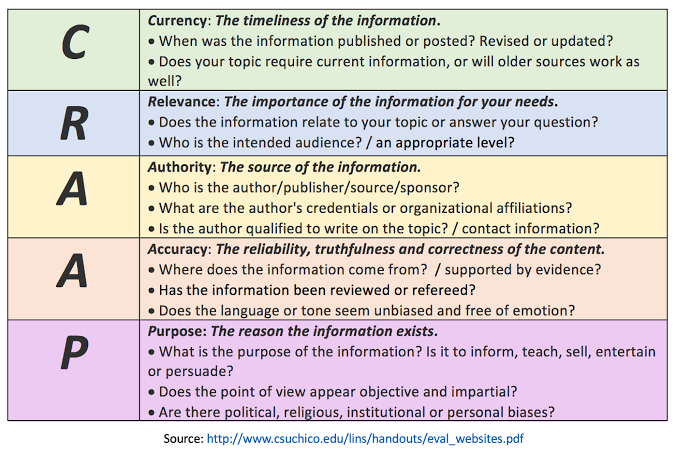
    4. Use the CRAAP Test to Evaluate Sources

    The CRAAP test is a practical checklist that helps students assess five important features of a source: Currency, Relevance, Authority, Accuracy, and Purpose. It is widely used in academic library instruction. <Cite refs={[“turn345701search0″,”turn345701search2”]}/>

    Currency: Is the information up to date?

    Check when the source was published and whether it has been revised.

    The appropriate date depends on your topic. Research on current educational technology or public policy may require recent evidence, while a historical analysis may rely on older primary documents.

    Ask whether newer evidence has changed the discussion and whether the source remains suitable for your assignment.

    Relevance: Does it answer your research question?

    A credible source may still be unsuitable for your paper if it does not address your topic directly.

    Check whether it covers the right subject, population, setting, and level of detail. Consider whether the source helps answer your question or simply mentions a related keyword.

    Authority: Who is responsible for it?

    Investigate the author, publisher, qualifications, and affiliations. Look for relevant expertise and information that helps you assess the source’s background.

    Do not judge authority from a website’s design or domain extension alone. A professional appearance does not prove that the content is accurate.

    Accuracy: Is it supported by evidence?

    Look for documented facts, appropriate methods, references, and conclusions that follow logically from the evidence.

    Compare important claims with independent sources. If a claim cannot be verified, treat it cautiously rather than repeating it as an established fact.

    Purpose: Why was it published?

    Consider whether the source aims to inform, educate, entertain, sell, persuade, or advocate for a particular position.

    Look for sponsorship, advertising, funding, conflicts of interest, and language designed to provoke a strong emotional reaction.

    A source can have a clear perspective and still provide valuable evidence. The important question is how that perspective affects what is included, emphasized, or omitted.

    5. Verify Online Sources With Lateral Reading

    Lateral reading means leaving the source you are examining to investigate it elsewhere. Instead of relying only on what a website says about itself, you search for independent information about its author, organization, claims, and reputation.

    This approach is particularly useful when evaluating unfamiliar websites, viral claims, and online reports. <Cite refs={[“turn345701search4″,”turn345701search5”]}/>

    Follow these steps:

    1. Pause before accepting the claim. Do not assume the first search result is the most reliable.
    2. Search for the author or organization. Look for independent reporting, institutional profiles, or credible evaluations.
    3. Find better coverage. Check whether reputable academic, professional, or public-interest sources discuss the same issue.
    4. Trace claims to their origin. Locate the original study, dataset, report, or quotation.
    5. Compare the evidence. Determine whether independent sources support the claim and whether they use the same context.

    For example, if a website states that a new teaching technique dramatically improves student performance, search for the original study. Examine the sample, research design, reported results, and limitations instead of relying solely on the website’s summary.

    Lateral reading does not mean that every claim needs dozens of searches. Focus your verification efforts on claims that are important, surprising, controversial, or difficult to check.

    6. Understand Bias, Funding, and Conflicts of Interest

    Bias can affect which questions researchers investigate, how results are interpreted, and which findings receive attention.

    Funding from a company, advocacy organization, or other interested party does not automatically invalidate a study. However, understanding who funded the research and whether the authors disclose conflicts of interest can help you interpret the results.

    Consider these questions:

    • Who funded the study or publication?
    • Do the authors disclose relevant financial or professional relationships?
    • Does the article acknowledge evidence that challenges its conclusions?
    • Are alternative explanations considered?
    • Does the language present evidence fairly or exaggerate the findings?

    For instance, research funded by a company evaluating its own educational software deserves careful examination of the study design, outcome measures, and disclosure statements. Its findings may be useful, but independent evidence can help you assess how broadly the conclusions should be applied.

    Also consider your own assumptions. You may be more likely to accept a source that supports your existing opinion. Evaluating opposing evidence helps you develop a more balanced academic argument.

    7. Check the Research Methodology and Limitations

    When using empirical research, do not focus only on the abstract or conclusion. Read the methods and limitations sections to understand how the researchers reached their findings.

    Look for:

    • The research question and design.
    • The number and characteristics of participants or observations.
    • How data were collected.
    • The measures used to assess outcomes.
    • The analytical methods.
    • The limitations acknowledged by the authors.

    Different research designs answer different questions. A randomized experiment may help investigate causal effects under particular conditions, while interviews may provide deeper insight into people’s experiences. Neither approach is automatically superior in every context.

    Be especially careful when an article claims that two variables are related. An association does not, by itself, establish that one variable caused the other.

    If the sample is limited to one institution or location, consider whether the findings can reasonably be applied to a wider population.

    8. Check Whether the Source Has Been Corrected or Retracted

    Research publications sometimes receive corrections, expressions of concern, or retraction notices after publication. These updates can change whether and how an article should be used.

    Before relying heavily on a research paper:

    • Check the publisher’s article page for correction or retraction notices.
    • Review any linked editorial statements.
    • Search the article title and DOI alongside terms such as “correction” or “retraction” when appropriate.
    • Check whether later research has challenged or failed to reproduce important findings.

    A retracted article may still be discussed in a paper about the history of a field, research misconduct, or the development of scientific knowledge. However, it should not normally be treated as reliable evidence for the original scientific claim without clearly explaining its status.

    For important findings, look for later studies and reviews that assess the wider evidence rather than relying on a single publication.

    9. Decide Whether a Source Belongs in Your Research Paper

    After evaluating a source, decide how it should be used. Not every source that passes basic credibility checks deserves a place in your final bibliography.

    A useful source should be both credible and relevant to your particular research question.

    For example, an authoritative government report may be ideal for official statistics, while a peer-reviewed experiment may be more suitable for evaluating a specific intervention. A textbook may explain foundational concepts, but a recent journal article may be better for discussing emerging research.

    You can classify your sources as follows:

    • Use: The source is relevant, sufficiently reliable, and appropriate for the claim you want to support.
    • Use with caution: The source offers useful information but has limitations, possible bias, or restricted applicability.
    • Seek stronger evidence: Important claims are unsupported, methods are unclear, or independent verification is lacking.
    • Exclude: The source is irrelevant, materially misleading, unverifiable, or unsuitable under your assignment’s requirements.

    Keep notes about why you selected important sources. This makes it easier to explain your research decisions and avoid repeating the same evaluation work later.

    Common Mistakes When Evaluating Academic Sources

    Avoid these common errors when researching for an assignment:

    • Trusting the top search result: Search ranking does not establish academic credibility.
    • Assuming every peer-reviewed article is correct: Review the methods, evidence, and limitations.
    • Judging by the domain name alone: A domain extension does not prove that a particular claim is reliable.
    • Ignoring publication dates: Old evidence may be inappropriate for fast-changing subjects.
    • Reading only the abstract: Important methodological details and limitations may appear elsewhere in the paper.
    • Accepting statistics without tracing them: Find the original report or dataset whenever possible.
    • Using only sources that agree with you: Evaluate competing evidence and alternative explanations.
    • Ignoring corrections or retractions: Verify the current status of important research papers.

    Academic Source Evaluation Checklist

    Before citing a source, use this checklist to review it.

    • The author or responsible organization is identifiable.
    • The author has relevant expertise or the source provides another credible basis for its authority.
    • The publication process is appropriate for the type of material.
    • The source directly supports my research question.
    • The claims are supported by evidence I can examine.
    • The methods and limitations are suitable for the conclusions.
    • The publication date is appropriate for my topic.
    • The purpose, funding, and possible conflicts of interest have been considered.
    • Important claims have been checked against independent sources.
    • I have checked for relevant corrections or retractions where necessary.
    • I can cite the source accurately and explain why it is useful.

    You do not need every source to be perfect. You do need to understand its strengths, limitations, and appropriate role in your paper.

    Frequently Asked Questions

    What is the easiest way to evaluate academic sources?

    Start with the CRAAP test: check Currency, Relevance, Authority, Accuracy, and Purpose. Then use lateral reading to verify the author, organization, and important claims through independent sources.

    Is Google Scholar enough to find credible sources?

    Google Scholar is useful for discovering scholarly literature, but inclusion in its results does not guarantee that every item is peer-reviewed or reliable. Check the original publication, author, research methods, and publication status before citing it.

    Are peer-reviewed articles always credible?

    Peer review adds a layer of expert scrutiny, but it does not eliminate errors, bias, weak methods, or later corrections. Evaluate the individual article and its evidence.

    Can I cite a university website in an academic paper?

    Yes, if the information is relevant, authoritative, and appropriate for your assignment. A university website may be useful for official policies or educational guidance, but a research question about a scientific finding may require the original study or a scholarly review.

    How many sources should I check before choosing one?

    There is no fixed number. Compare enough independent evidence to judge the source and support the claim you want to make. Important or controversial claims usually require more careful verification than routine background information.

    What should I do if two credible sources disagree?

    Compare their dates, research questions, methods, populations, measurements, and limitations. The apparent disagreement may reflect different circumstances or outcomes. Explain the uncertainty fairly rather than choosing one source simply because it supports your argument.

    Conclusion

    Learning how to evaluate academic sources is essential for producing accurate, credible, and persuasive research. Check the author’s expertise, examine the publisher, assess the evidence, and consider the source’s purpose and possible limitations.

    Use the CRAAP test as a practical starting point, then apply lateral reading to verify important claims independently. For research studies, investigate the methodology, limitations, and publication status before relying on the findings.

    The goal is not simply to collect sources that look academic. It is to select evidence that genuinely supports your research question and to use that evidence responsibly. These habits will help you write stronger assignments, make better research decisions, and develop critical thinking skills that extend beyond university.

  • How to Write a Literature Review for a Research Paper

    How to Write a Literature Review for a Research Paper

    A literature review is an essential part of many academic research papers, dissertations, and university projects. It explains what researchers already know about a topic, compares important findings, and identifies questions that still need further investigation. A well-written literature review helps readers understand the background of your research and why your study matters.

    Learning how to write a literature review involves more than collecting articles and summarizing them. You must evaluate the quality of existing research, identify relationships between studies, and organize the evidence into a clear discussion that supports your research question.

    Whether you are preparing an undergraduate assignment, a graduate dissertation, or a standalone review paper, this guide explains how to plan, research, organize, and write an effective literature review.

    What Is a Literature Review?

    A literature review is a structured discussion of published research and other scholarly sources related to a specific topic or research question. It summarizes relevant knowledge while comparing, interpreting, and evaluating the evidence.

    For example, if you are researching how online learning affects university students, your literature review might examine studies on student engagement, academic performance, instructor feedback, and access to technology.

    Rather than describing each study separately, you would explain where the findings agree, where they differ, and what those patterns suggest about your research question.

    A literature review may appear as a section within a research paper or dissertation, or it may be written as a standalone academic paper. Its length and structure depend on the assignment, discipline, and purpose.

    Why Is a Literature Review Important?

    A strong literature review establishes the academic foundation for your research. It helps you understand the existing discussion before developing your own study.

    Its main purposes include:

    • Providing background: Explains the key concepts, theories, and findings related to your topic.
    • Identifying research gaps: Shows which questions remain unanswered or insufficiently explored.
    • Comparing evidence: Highlights agreements, disagreements, and patterns across studies.
    • Improving research design: Helps you identify methods, measures, and approaches used by previous researchers.
    • Justifying your study: Explains how your project relates to and may contribute to existing knowledge.

    A literature review also demonstrates that your research question is informed by relevant scholarship rather than developed in isolation.

    Step 1: Define Your Research Question

    Before searching for sources, decide what you want your literature review to investigate. A broad topic can produce too many results and make it difficult to identify relevant evidence.

    For example:

    Broad topic: Online learning.

    More focused question: How does instructor feedback influence student engagement in online university courses?

    The focused question identifies a particular factor, outcome, and educational setting. It gives you a clearer basis for deciding which studies to include.

    To refine your question, ask yourself:

    • What specific problem or issue am I investigating?
    • Which population, setting, or subject area matters?
    • What relationship, experience, or outcome do I want to understand?
    • What can I realistically cover within the assignment requirements?

    Your question may change as you discover more about the research. That is normal. Keep it focused enough to guide your reading while allowing room for important findings you did not initially expect.

    Step 2: Search for Relevant Academic Sources

    Once your research question is clear, begin searching for scholarly literature. Useful sources may include peer-reviewed journal articles, academic books, systematic reviews, conference papers, and credible reports relevant to your discipline.

    Common places to search include:

    • Google Scholar for discovering academic publications.
    • University library databases for subject-specific research.
    • PubMed for biomedical and life-science literature.
    • ERIC for education research.
    • JSTOR for scholarship across humanities and social sciences.

    Choose databases that match your subject and the requirements of your assignment.

    Use focused search terms

    Start with the main concepts in your research question. Try synonyms and related phrases to find studies that use different terminology.

    For example, a search about instructor feedback and online student engagement could use phrases such as:

    • instructor feedback in online learning
    • student engagement in virtual classrooms
    • online course feedback and participation
    • university e-learning student engagement

    You can combine terms with Boolean operators. AND narrows a search to results containing both concepts, OR expands it to include alternatives, and quotation marks can help search for an exact phrase when supported by the database.

    For instance, searching for "online learning" AND "student engagement" can help you locate research connecting those concepts.

    Set sensible inclusion criteria

    Do not collect sources simply because they mention your topic. Decide which sources are relevant to your question and credible enough to inform your review.

    Depending on your project, you may prioritize:

    • Research published within a specified date range.
    • Studies involving a relevant population or setting.
    • Peer-reviewed scholarly publications.
    • Sources that directly investigate your main concepts.
    • Foundational studies that established important theories or methods.

    Recent research is particularly important in rapidly changing fields, but older studies may remain essential when they introduced influential concepts or established the background of a research area.

    Step 3: Evaluate the Quality of Your Sources

    Not every publication provides equally strong evidence. Before including a source, examine its credibility, relevance, methodology, and limitations.

    Use the following questions as a guide:

    Authority: Who conducted the research, and where was it published?

    Relevance: Does the source directly help answer your research question?

    Methodology: Is the research design appropriate for the question being investigated?

    Evidence: Are the conclusions supported by the data and analysis presented?

    Limitations: Do the authors identify weaknesses, uncertainty, or restrictions on how their findings should be interpreted?

    Currency: Is the publication recent enough for your topic, or is it an important foundational work?

    For empirical studies, pay attention to sample size, participant characteristics, research setting, measurement methods, and possible sources of bias. These details can help explain why two studies reach different conclusions.

    A credible literature review does not automatically accept every published finding. It considers how much confidence the evidence deserves.

    Step 4: Take Organized Notes While Reading

    Taking structured notes saves time when you begin writing. If you rely on memory or scattered highlights, it can become difficult to compare studies accurately.

    Create a literature review matrix to record key information from each source.

    InformationWhat to record
    CitationAuthor, year, title, publication, and DOI or stable link
    Research purposeMain question or objective
    MethodologyDesign, sample, data collection, and analysis
    Main findingsResults relevant to your research question
    LimitationsWeaknesses or restrictions identified in the study
    ConnectionHow the source relates to other studies and your project

    For example, if three studies investigate online student engagement, your notes may reveal that they measure engagement differently. One might examine attendance, another discussion participation, and a third student-reported motivation.

    Recording these distinctions helps you avoid treating findings as directly comparable when the studies measure different outcomes.

    Always record citation details as you read. This reduces the risk of missing references or accidentally presenting another researcher’s ideas as your own.

    Step 5: Identify Themes, Patterns, and Research Gaps

    This is one of the most important stages of writing a literature review. After reading your sources, look for connections between them rather than treating each publication as an isolated piece of information.

    Look for recurring themes

    Group studies that investigate similar questions or report related findings. For a review of online learning, possible themes might include:

    • Student motivation and engagement.
    • Instructor communication and feedback.
    • Technology access and digital barriers.
    • Course design and learning outcomes.

    These themes can become the main sections of your review.

    Compare agreements and disagreements

    Researchers may reach similar conclusions for different reasons, or their findings may conflict. Examine whether differences in methodology, population, context, or measurement could help explain the results.

    For example, one study may report that recorded lectures improve students’ confidence, while another finds little change in examination performance. These findings are not necessarily contradictory because confidence and performance are different outcomes.

    Your task is to explain what the evidence shows, what remains uncertain, and how the findings relate to one another.

    Identify research gaps carefully

    A research gap is an important question, population, relationship, or context that existing literature has not adequately addressed.

    Possible gaps include:

    • Limited research on a particular population.
    • Inconsistent findings across studies.
    • Few studies examining a specific setting.
    • Weaknesses in commonly used research methods.
    • A lack of evidence about long-term outcomes.

    Do not claim that no research exists simply because you did not find it in one database. Explain the limits of your search and support any gap claim with the evidence you reviewed.

    Step 6: Choose the Best Structure for Your Literature Review

    The right structure depends on the purpose of your review and the nature of the literature.

    Thematic structure

    Organize the review around recurring concepts or topics. This is useful when several related themes emerge across the literature.

    For example, a review of online learning could have sections on engagement, feedback, technology access, and assessment.

    Chronological structure

    Arrange sources by time to show how ideas, methods, or findings have developed. This works well when the history of a research area is important.

    Avoid simply listing publications by year. Explain what changed and why those developments matter.

    Methodological structure

    Group studies according to the methods they use, such as surveys, interviews, experiments, or case studies. This can help you evaluate how different approaches affect the evidence.

    Theoretical structure

    Organize the review around theories or conceptual frameworks that researchers use to explain a problem. This is useful when competing theories offer different interpretations of the same topic.

    You can combine approaches when doing so improves clarity. For many student assignments, a thematic structure is a practical starting point.

    Step 7: Write the Introduction, Body, and Conclusion

    Most literature reviews follow an introduction-body-conclusion structure, although the amount of space given to each section depends on whether the review is standalone or part of a larger paper.

    Introduction

    Introduce the topic, explain why it matters, define the scope of the review, and state its guiding question or purpose.

    Briefly tell readers how the discussion is organized. If you are writing a formal systematic or scoping review, you may also need to explain the search strategy and selection criteria in a dedicated methods section.

    Body

    Organize the main discussion into sections based on your chosen structure. Each paragraph should develop a clear point and connect relevant sources.

    A useful paragraph pattern is:

    1. Introduce the theme or claim.
    2. Present findings from relevant studies.
    3. Compare similarities and differences.
    4. Evaluate the strength or limitations of the evidence.
    5. Explain how the discussion relates to your research question.

    This structure keeps your analysis at the center instead of turning the review into a sequence of summaries.

    Conclusion

    Summarize the main patterns and conclusions that emerge from the literature. Explain what is reasonably well established, what remains uncertain, and how the review informs your own project.

    If relevant, identify a justified research gap or explain why further investigation is needed. Avoid introducing major new sources or making claims that the review has not established.

    Step 8: Synthesize Sources Instead of Summarizing Them One by One

    A common weakness is writing one paragraph about each article without explaining how the studies relate to each other.

    Summary-only approach:

    “Study A investigated online feedback. Study B examined student participation. Study C studied academic performance.”

    This reports what the researchers did but does not develop an overall interpretation.

    Synthesis approach:

    “Across the reviewed studies, timely instructor feedback appears closely connected to students’ participation in online courses. However, the evidence is less consistent regarding its relationship with academic performance, partly because studies use different outcome measures and research designs.”

    This example connects findings and highlights a possible reason for variation. In your own paper, support such statements with citations to the actual studies you reviewed.

    Useful phrases for synthesis include:

    • “Several studies suggest that…”
    • “In contrast, other researchers found…”
    • “A recurring pattern across the literature is…”
    • “These findings differ partly in their…”
    • “Taken together, the evidence indicates…”
    • “An important limitation of the existing research is…”

    Use these expressions only when they accurately reflect your sources. Clear synthesis requires careful reading, not just sophisticated transitions.

    Common Literature Review Mistakes to Avoid

    Watch out for these frequent problems:

    • Summarizing every source separately: Group sources around ideas and compare their contributions.
    • Including irrelevant research: Keep each source connected to your research question.
    • Using too many direct quotations: Summarize and paraphrase accurately in your own words, with appropriate citations.
    • Ignoring conflicting evidence: Discuss disagreements instead of selecting only findings that support your expectations.
    • Making unsupported gap claims: Base claims about missing research on a careful search.
    • Relying only on older sources: Include relevant recent work where appropriate while retaining important foundational studies.
    • Using inconsistent citations: Follow the required citation style, such as APA, MLA, Chicago, or another discipline-specific format.
    • Writing without a clear structure: Use headings and transitions to make the relationships between themes easy to follow.

    Final Checklist Before Submitting

    Use this checklist to review your literature review:

    • The research question and scope are clearly defined.
    • The sources are relevant, credible, and appropriate for the topic.
    • The search and selection process meets the assignment requirements.
    • The review compares and synthesizes studies rather than merely listing them.
    • Major themes, disagreements, and limitations are discussed.
    • Claims about research gaps are supported by the reviewed evidence.
    • Every borrowed idea and finding is cited correctly.
    • The introduction, body, and conclusion work together.
    • The final review explains how existing research relates to the project.

    Frequently Asked Questions

    How many sources should a literature review include?

    There is no universal number. The appropriate amount depends on the assignment, the length of the review, the scope of the topic, and the amount of relevant research available. Follow your instructor’s requirements and prioritize the most useful, credible sources over an arbitrary target.

    How long should a literature review be?

    A literature review can range from a few paragraphs in a short research paper to a substantial chapter in a dissertation. Its length should reflect the purpose and scope of the project rather than a fixed word count.

    What is the difference between a literature review and an annotated bibliography?

    An annotated bibliography usually presents individual sources with a short summary and evaluation for each. A literature review organizes sources into a connected discussion, comparing and synthesizing their findings around a broader question or theme.

    Should a literature review include recent studies?

    Yes, when recent evidence is relevant to the topic. In fast-changing fields, current research may be especially important. However, older publications should not be excluded automatically if they provide essential theories, methods, or historical context.

    Can I use AI tools to help with a literature review?

    AI tools may help brainstorm search terms, organize notes, or improve the clarity of your writing, but you should independently verify sources, findings, and references. Never cite a paper you have not checked or rely on an AI-generated summary as a substitute for reading the original research. Follow your institution’s academic-integrity and AI-use policies.

    Conclusion

    Learning how to write a literature review requires a systematic approach to searching, evaluating, organizing, and interpreting academic research. Start with a focused question, select relevant sources, take structured notes, and identify the themes that connect the literature.

    Most importantly, move beyond describing individual publications. Compare their findings, assess their limitations, explain disagreements, and show what the evidence means for your research question. A thoughtful literature review gives your project a stronger academic foundation and helps readers understand how it fits into the wider scholarly discussion.

  • How to Write a Strong Thesis Statement for an Academic Essay

    How to Write a Strong Thesis Statement for an Academic Essay

    A strong thesis statement is the foundation of a well-organized academic essay. It tells readers the main point of your paper, establishes its direction, and helps you decide which ideas and evidence belong in your discussion. Whether you are writing an argumentative essay, literary analysis, research paper, or assignment for a university course, a clear thesis can make your writing more focused and persuasive.

    Learning how to write a strong thesis statement involves more than summarizing a topic. You need to develop a specific central idea, explain what you want to demonstrate, and make sure your essay can support that idea with relevant evidence.

    This guide explains how to create an effective thesis statement, provides practical examples, and highlights common mistakes to avoid.

    What Is a Thesis Statement?

    A thesis statement is the central claim, interpretation, or main idea that guides an academic essay. It tells readers what your paper is about and what you want them to understand by the end.

    In an argumentative essay, a thesis usually presents a position that you will defend with evidence. In an analytical essay, it communicates your interpretation of a subject. In an explanatory paper, it identifies the main point your discussion will develop.

    For example:

    Weak thesis: Social media affects students.

    Stronger thesis: Excessive social media use can disrupt university students’ concentration by encouraging frequent task-switching and interrupting focused study sessions.

    The stronger example identifies a specific issue and explains the relationship the essay will examine. It also gives the writer a clear direction for developing the main sections.

    A thesis statement commonly appears near the end of the introduction, although its placement can vary depending on the assignment, discipline, and writing style.

    Why Is a Strong Thesis Statement Important?

    An effective thesis helps both the writer and the reader understand the purpose of an essay.

    • Provides direction: It establishes the central idea that your paragraphs should develop.
    • Improves organization: It helps you arrange supporting points in a logical order.
    • Clarifies your purpose: It explains what your essay aims to demonstrate, interpret, or explain.
    • Guides research: It helps you identify which sources and evidence are relevant.
    • Creates reader expectations: It gives readers a clear idea of what the essay will discuss.

    Without a clear thesis, an essay may contain useful information but lack a central argument. A focused statement helps connect individual paragraphs to one overall purpose.

    Characteristics of a Strong Thesis Statement

    Before learning the writing process, understand the features that distinguish an effective thesis from a vague or overly broad one.

    1. It Is Specific and Focused

    A thesis should identify a manageable issue rather than cover an entire subject.

    Too broad: Technology has changed education.

    More focused: Interactive online simulations can help biology students visualize complex processes when they are combined with guided practice and instructor feedback.

    The revised statement gives the essay a narrower subject and identifies specific aspects to investigate.

    2. It Presents a Clear Main Idea

    Readers should be able to identify the central point without guessing what the writer means.

    Unclear: There are many interesting things to consider about university attendance.

    Clearer: Flexible attendance policies can support university students with unavoidable work and caregiving responsibilities, provided that essential learning activities remain accessible.

    The second statement communicates a specific position and introduces a condition that the essay can examine.

    3. It Is Defensible With Evidence

    An argumentative thesis should make a claim that can be examined, questioned, or supported through reasoning and evidence.

    Weak: Reading is important.

    Stronger: Schools should provide structured independent-reading time because it gives students regular opportunities to develop reading fluency, explore their interests, and practice comprehension.

    The stronger version gives readers reasons to consider and evaluate the position.

    Not every academic paper needs a controversial argument. An explanatory or analytical assignment may require a clear interpretation or central conclusion instead.

    4. It Matches the Assignment

    Your thesis must answer the question your instructor has asked.

    If the prompt asks you to compare two learning methods, a statement that only describes one method will not fully address the task. Read the assignment carefully, identify its main instruction, and shape your thesis around that requirement.

    5. It Is Manageable Within the Available Space

    A short essay cannot thoroughly investigate every aspect of a complicated subject. Choose a claim that you can develop using the available word count, sources, and time.

    A focused argument usually produces a more coherent essay than an ambitious statement that promises more than the paper can demonstrate.

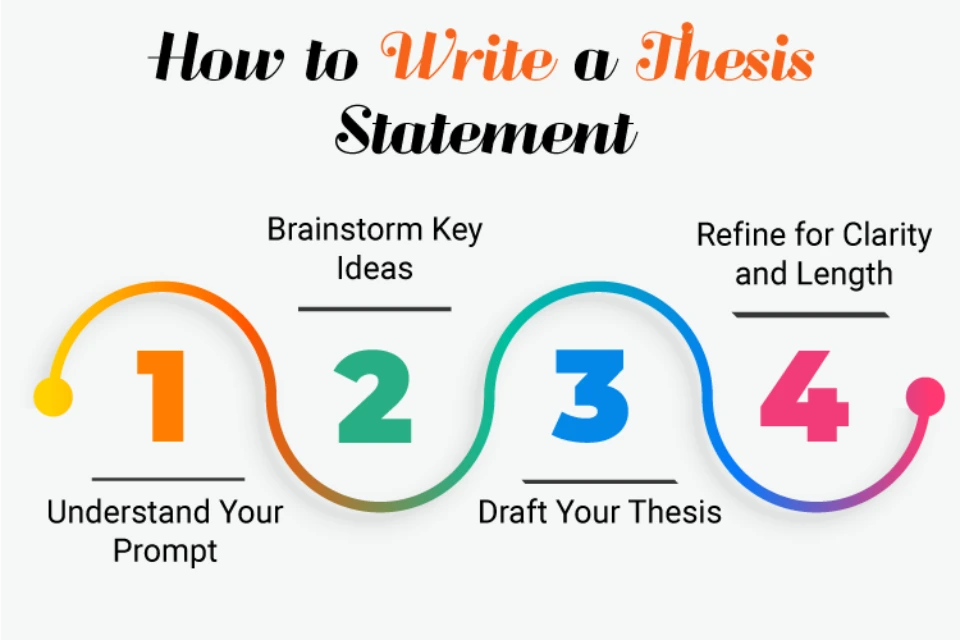
    How to Write a Strong Thesis Statement Step by Step

    Follow this practical process when planning an academic essay.

    Step 1: Understand the Essay Prompt

    Begin by identifying the task. Are you being asked to argue, analyze, compare, evaluate, or explain?

    For example, a prompt might ask you to evaluate whether group projects improve university learning. Your thesis should offer an evaluation rather than merely define group projects.

    Underline the main topic and identify what your instructor expects you to do with it.

    Step 2: Narrow Your Topic

    Broad subjects are often difficult to develop in a short paper. Narrow your topic by considering a particular group, setting, problem, cause, or outcome.

    Suppose your initial topic is online learning. You could narrow it to online learning for first-year university students, then focus further on how instructor feedback affects participation.

    A narrower topic makes it easier to formulate a meaningful central idea and select appropriate evidence.

    Step 3: Ask a Question About Your Topic

    Turn your subject into a question that your essay can answer.

    For example:

    Topic: Recorded university lectures.

    Research question: How do recorded lectures affect students who need to review difficult course material?

    Your answer to this question can become the starting point for your thesis. If the evidence changes your understanding, you can revise the statement as your research develops.

    Step 4: Develop a Preliminary Answer

    Write a direct answer to your question in one sentence. Do not worry about making it perfect at this stage.

    Preliminary answer: Recorded lectures help students review difficult material.

    This is a useful starting point, but it needs more precision. Think about which students benefit, under what circumstances, and why.

    Step 5: Add a Specific Claim and Supporting Reasoning

    Improve your preliminary answer by identifying the main reason behind your position.

    Revised thesis: Recorded university lectures can support students’ understanding of difficult course material by allowing them to revisit explanations and review challenging concepts at their own pace.

    This version explains how the practice may help students and gives the essay a direction. The final paper should support the claim with appropriate evidence rather than assuming the benefit applies equally to every student.

    Step 6: Check Your Evidence

    Ask whether you can find reliable evidence to support your statement. Consider academic research, relevant examples, assigned readings, and credible sources.

    If you cannot support the claim, you may need to narrow it, change your position, or gather more information.

    A thesis should guide your research, but it should not prevent you from reconsidering your original idea when the evidence points elsewhere.

    Step 7: Revise After Drafting

    Your understanding of a topic often improves while writing. Once you have drafted the main sections, compare your essay with your thesis.

    Does every major section contribute to the central idea? Does your evidence support the claim you initially made? If the essay has developed in a different direction, revise the thesis to reflect what the paper actually demonstrates.

    Strong Thesis Statement Examples for Different Essays

    The best thesis format depends on the assignment. These examples show how a central idea can be expressed across different academic writing styles.

    Argumentative Essay

    Topic: University attendance policies.

    Thesis: Universities should offer reasonable attendance flexibility for students facing documented personal or health-related challenges while maintaining clear academic participation requirements.

    This statement takes a position and establishes the balance the essay will examine.

    Analytical Essay

    Topic: A character in a novel.

    Thesis: The protagonist’s changing relationship with authority reveals how fear of social rejection can influence personal decisions.

    This thesis presents an interpretation that the essay can develop through close analysis of the text.

    Compare-and-Contrast Essay

    Topic: Printed and digital textbooks.

    Thesis: Although printed and digital textbooks provide access to the same course material, their differences in navigation, portability, and annotation options can influence how students study.

    This statement identifies the comparison and the dimensions the essay will explore.

    Explanatory Essay

    Topic: Urban heat islands.

    Thesis: Urban heat islands develop when built surfaces absorb and retain heat, while limited vegetation reduces the cooling effects of shade and evaporation.

    This thesis identifies the main explanation the essay will develop. For a scientific paper, claims should be supported by appropriate research.

    Research Paper

    Topic: Student participation in online courses.

    Thesis: Student participation in online courses is shaped by several interacting factors, including course design, opportunities for interaction, and the clarity of learning expectations.

    This statement identifies a focused area of investigation without claiming that one factor explains every student’s experience.

    Common Thesis Statement Mistakes to Avoid

    Even a promising idea can become ineffective if it is expressed poorly. Watch out for these common problems.

    • Being too vague: Replace broad claims with a specific interpretation, position, or explanation.
    • Announcing the essay instead of stating its point: Instead of writing “This essay will discuss online learning,” explain what your essay will show about online learning.
    • Including unrelated ideas: Keep the thesis centered on one main argument or connected purpose.
    • Making unsupported claims: Avoid statements that require evidence you cannot reasonably obtain.
    • Using overly absolute language: Words such as “always,” “never,” and “everyone” may make a claim unnecessarily difficult to defend.
    • Treating your first draft as final: Revisit your thesis after researching and drafting the essay.
    • Ignoring the assignment prompt: A well-written statement is still ineffective if it answers the wrong question.

    Thesis Statement Checklist Before You Submit

    Use this checklist to review your thesis before handing in your essay.

    • Does it answer the assignment question?
    • Is the main idea clear and specific?
    • Does it match the type of essay I am writing?
    • Can I support it with evidence and logical reasoning?
    • Is the topic narrow enough for the available word count?
    • Do the main sections of my essay develop this idea?
    • Have I removed unnecessary wording and vague expressions?
    • Does the thesis accurately represent my completed paper?

    If you answer “no” to any question, revise the statement before completing your final draft.

    Frequently Asked Questions

    How long should a thesis statement be?

    For many short academic essays, one well-developed sentence is enough. Longer research papers may need a more detailed statement or a short thesis paragraph. Follow your assignment guidelines and prioritize clarity over length.

    Where should a thesis statement appear?

    It commonly appears near the end of the introduction, where it prepares readers for the main discussion. However, some disciplines and assignments use different structures.

    Can a thesis statement be a question?

    A research question can guide your investigation, but most argumentative essays need a statement that answers the question and communicates the central claim. Other academic formats may use different conventions.

    Can I change my thesis after writing the essay?

    Yes. A thesis is often a working statement that develops as you read, research, and write. Revising it helps ensure that the final version accurately reflects your evidence and conclusions.

    Does every academic essay need a thesis statement?

    Many academic essays need a clear central idea, but its form depends on the assignment. A reflective essay, for example, may use a personal insight, while a research essay may present an analytical claim. Follow your instructor’s requirements.

    Final Thoughts

    Writing a strong thesis statement begins with understanding the assignment, narrowing the topic, and answering a focused question. The statement should communicate a clear central idea, fit the scope of your paper, and provide a direction that your evidence can support.

    Do not worry if your first attempt is imperfect. Develop a preliminary thesis, research your topic, draft the essay, and revise the statement when your understanding improves. With practice, you can create thesis statements that make academic writing more organized, focused, and meaningful

  • How Education Encourages Innovation and New Ideas

    How Education Encourages Innovation and New Ideas

    Education has always played an important role in human progress. From scientific discoveries to technological developments, many important changes have been supported by people who were willing to learn, question existing ideas, and search for better solutions. In the modern world, education is becoming even more important because innovation is influencing almost every industry and creating new opportunities for individuals and communities.

    Education Creates a Culture of Curiosity

    Innovation often begins with a simple question: “Is there a better way to do this?” Education can encourage students to develop this kind of curiosity.

    Instead of teaching learners to accept information without examination, effective education can encourage them to ask questions, explore subjects, and understand how different ideas are connected. Curiosity motivates students to investigate problems and discover possibilities that may not be immediately obvious.

    A classroom that supports questions and discussion can therefore become an environment where new ideas develop naturally.

    Connecting Knowledge With Practical Problems

    Academic knowledge becomes especially valuable when students can apply it to real-world situations. Practical projects allow learners to move from theory to action.

    For example, students may design a simple business plan, develop a technology project, conduct scientific research, or create a solution to a community problem. These activities can teach them how to identify challenges, test ideas, evaluate results, and make improvements.

    This process is similar to how innovation works in professional environments.

    The Role of Technology in Innovation

    Technology has expanded the possibilities available to students and educators. Computers, online learning platforms, digital research tools, software applications, and modern laboratory equipment can give learners access to resources that were previously difficult to obtain.

    Students can also collaborate with people in different locations through digital communication tools. This can allow ideas to move across geographical boundaries and expose learners to different approaches.

    However, technology itself does not guarantee innovation. Its value depends on how effectively students and teachers use it to explore ideas, solve problems, and create useful outcomes.

    Encouraging Creative Thinking

    Creativity is closely connected with innovation. Students who are encouraged to think creatively can learn to approach problems from different perspectives.

    Creative thinking can be developed through writing, design, art, experiments, entrepreneurship, coding, research, and project-based learning. These activities give students opportunities to explore multiple possibilities instead of searching for only one correct answer.

    When students understand that mistakes can be part of the learning process, they may become more willing to experiment and improve their ideas.

    Collaboration and Innovation

    Many modern innovations are created through teamwork rather than individual effort. Education can prepare students for collaborative work by including group projects and shared problem-solving activities.

    Working in teams teaches learners how to communicate ideas, listen to others, divide responsibilities, and combine different skills. A student with strong technical knowledge may work with another who has excellent communication or creative abilities.

    This combination of different strengths can lead to more complete and practical solutions.

    Research as a Foundation for Progress

    Research is another important part of innovation. It allows students to investigate questions systematically and develop conclusions based on evidence.

    Schools and universities can encourage research by providing access to libraries, laboratories, digital resources, and experienced teachers. Research projects can help learners develop patience, analytical thinking, and attention to detail.

    These skills are valuable not only in academic environments but also in business, technology, healthcare, engineering, and many other professional fields.

    Preparing Future Entrepreneurs

    Education can also support entrepreneurship by teaching students how ideas can become practical projects or businesses. Entrepreneurship education may introduce learners to planning, budgeting, marketing, customer needs, communication, and risk management.

    Students can learn how to identify problems that people face and consider whether innovative products or services could address those problems.

    This approach encourages learners to think about creating value rather than simply looking for existing opportunities.

    Lifelong Innovation Through Learning

    Innovation does not stop when students graduate. Professionals in almost every field need to continue learning because technologies, customer expectations, and industry practices change over time.

    Lifelong learning allows individuals to update their knowledge, explore new ideas, and improve their professional abilities. Online courses, workshops, certifications, conferences, books, and practical experience can all support continuous development.

    Conclusion

    Education provides an important foundation for innovation by encouraging curiosity, creativity, research, practical learning, and collaboration. Students who learn how to question problems and develop thoughtful solutions can become better prepared to contribute to a changing world.

    As technology continues to evolve, educational institutions have an opportunity to create learning environments that support experimentation and independent thinking. By connecting knowledg

  • The Benefits of Quality Education for Students and Society

    The Benefits of Quality Education for Students and Society

    Quality education is a valuable foundation for individual development and social progress. It gives people the opportunity to gain knowledge, understand important concepts, develop useful abilities, and prepare for future responsibilities. A strong education system does more than help students achieve academic results; it can also prepare them to become capable professionals, thoughtful individuals, and active members of their communities.

    Improving Knowledge and Understanding

    Education provides students with structured opportunities to learn about the world. Subjects such as science, mathematics, literature, history, technology, and social studies introduce learners to different ideas and ways of understanding problems.

    A broad education can help students connect information from different subjects. For example, knowledge of technology can support business studies, while communication skills can be useful in almost every professional field. This combination of knowledge can give learners a stronger foundation for future development.

    Developing Independent Learners

    One important goal of education is to help students become independent learners. Instead of depending entirely on teachers for information, students can learn how to research topics, evaluate resources, ask questions, and find solutions.

    Independent learning becomes particularly valuable after formal education. Professionals often need to learn new tools and concepts without returning to a traditional classroom. Developing good learning habits early can make this process easier later in life.

    Encouraging Creativity

    Creativity is an important part of learning. Students should have opportunities to explore ideas, experiment with different approaches, and develop original solutions.

    Creative activities can include writing, art, research, science experiments, design projects, and technology-based assignments. Such activities allow learners to move beyond memorization and think about how knowledge can be applied in new ways.

    Creativity can also support problem-solving because students learn to consider multiple possible approaches to a challenge.

    Preparing for Professional Life

    Education can help students prepare for the workplace by combining academic knowledge with practical skills. Employers in different industries may require abilities such as communication, organization, teamwork, digital literacy, and analytical thinking.

    Internships, practical projects, workshops, and career-focused programs can give students experience with real-world tasks. These opportunities can help learners understand how their education connects with professional responsibilities.

    Career preparation should also include guidance that helps students understand their interests and identify areas where they may want to develop specialized skills.

    Supporting Economic Development

    Education can contribute to economic development by helping create a skilled workforce. Businesses and organizations depend on people with knowledge and practical abilities to provide services, develop products, manage operations, and introduce new ideas.

    When individuals have access to quality learning opportunities, they can develop skills that support different sectors of the economy. Education can therefore have benefits that extend beyond individual careers and contribute to broader economic activity.

    Promoting Social Understanding

    Educational institutions bring together students from different backgrounds and experiences. This provides opportunities for learners to communicate with people who may have different perspectives.

    Classroom discussions, group activities, and cultural studies can encourage students to listen to others and communicate respectfully. Developing these qualities can help individuals work effectively with different people in their future personal and professional lives.

    The Growing Importance of Digital Skills

    Digital knowledge has become increasingly useful in education and employment. Students may need to use online research tools, productivity software, communication platforms, and other digital resources.

    Digital education should also teach students how to evaluate online information and use technology responsibly. Understanding how to identify reliable sources is an important part of learning in an environment where information is widely available.

    Making Education More Accessible

    The benefits of education can reach more people when learning opportunities are accessible and affordable. Schools and educational organizations can support accessibility through scholarships, digital learning resources, community programs, libraries, and flexible learning options.

    Online education has also created additional opportunities for learners who may face geographical or scheduling limitations. With appropriate support and reliable resources, digital learning can complement traditional education.

    Conclusion

    Quality education provides benefits that extend far beyond academic achievement. It develops knowledge, creativity, independence, communication, practical skills, and social understanding. It can also help individuals prepare for professional opportunities while contributing to stronger communities and economic development.

    As the world continues to change, education must remain adaptable and focused on the needs of modern learners. By improving teaching quality, supporting digital learning, encouraging practical experience, and expanding access to educational resources, society can create better opportunities for students and future generations.

  • The Importance of a Supportive Learning Environment for Students

    The Importance of a Supportive Learning Environment for Students

    A positive learning environment can have a significant influence on how students understand subjects, develop confidence, and participate in educational activities. Education is not only about books, classrooms, and examinations. The environment in which students learn can also shape their motivation, creativity, communication, and attitude toward learning.

    A supportive educational environment gives students the opportunity to ask questions, make mistakes, explore ideas, and improve their abilities without unnecessary fear. When learners feel respected and encouraged, they are more likely to participate actively and take greater responsibility for their education.

    Creating a Comfortable Classroom

    A comfortable classroom can make learning more engaging. Students should have access to appropriate learning materials, suitable facilities, and an environment where they can concentrate on their studies.

    Teachers can contribute by creating clear expectations and encouraging respectful communication. Simple practices such as allowing students to ask questions and giving constructive feedback can make classroom interactions more productive.

    A positive classroom does not mean that students should avoid challenges. Instead, it means learners should have the support they need while working through difficult subjects and activities.

    The Role of Teacher Support

    Teachers have an important influence on the learning experience. An effective teacher can explain difficult concepts, identify areas where students need additional assistance, and encourage learners to continue improving.

    Feedback is particularly valuable. Instead of simply pointing out mistakes, constructive feedback can explain how students can improve. This approach helps learners understand that mistakes can become opportunities for learning.

    Teachers can also encourage students to develop independent learning habits so they gradually become more confident in managing their own education.

    Encouraging Student Participation

    Active participation can make education more meaningful. Students can learn through discussions, presentations, group projects, practical activities, research, and classroom questions.

    When students participate, they have opportunities to express their ideas and listen to different perspectives. This can improve communication skills and encourage deeper understanding of academic subjects.

    Participation can also help teachers identify which topics students understand well and which areas require additional explanation.

    The Value of Peer Learning

    Students can learn a great deal from one another. Group activities allow learners to exchange ideas, explain concepts, and work together toward shared goals.

    Peer learning can be particularly useful when students have different strengths. One student may understand a particular concept well while another may contribute strong research or presentation skills.

    Learning together can therefore create a collaborative atmosphere and teach students how to cooperate with people who have different abilities and perspectives.

    Using Technology Effectively

    Modern technology provides educational institutions with additional ways to support students. Online resources, digital libraries, educational software, and virtual learning platforms can supplement traditional classroom instruction.

    Technology can make it easier for students to review lessons, conduct research, and access additional learning materials. However, digital tools should be selected according to educational needs rather than used simply because they are available.

    Teachers can guide students toward reliable resources and help them develop responsible digital learning habits.

    Supporting Different Learning Needs

    Every student has a unique learning experience. Some learners may understand a topic quickly, while others may require additional explanations or practice.

    A supportive education system recognizes these differences. Teachers can use different teaching methods, examples, exercises, and learning materials to make lessons accessible to a wider range of students.

    Providing appropriate support can help learners remain engaged and make steady academic progress.

    Building Confidence Through Activities

    Education should provide opportunities for students to discover and develop their abilities. Sports, creative projects, debates, science activities, technology projects, and extracurricular programs can complement academic learning.

    These activities can help students discover interests that may not be visible through traditional classroom subjects. They can also develop qualities such as teamwork, leadership, creativity, discipline, and confidence.

    Preparing Students for the Future

    A supportive learning environment can prepare students for more than examinations. It can help them develop skills that are useful in higher education, professional careers, and everyday life.

    Students who learn how to communicate, collaborate, solve problems, manage responsibilities, and continue learning can be better prepared to handle future challenges.

    Conclusion

    A supportive learning environment is an important part of effective education. Quality facilities, dedicated teachers, active participation, peer learning, appropriate technology, and individual support can all contribute to a productive educational experience.

    The goal of education should be to create an environment where students can develop knowledge while also building confidence, practical skills, and a willingness to learn. When students receive the right support and opportunities, education can become a powerful foundation for their personal and professional development.

  • The Role of Education in Creating Opportunities for the Future

    The Role of Education in Creating Opportunities for the Future

    Education is a fundamental part of human development and an important foundation for a successful society. It gives individuals the knowledge and skills required to understand the world, overcome challenges, and create meaningful opportunities. In today’s competitive environment, education is more than simply earning academic qualifications. It is a continuous process that develops confidence, creativity, critical thinking, and the ability to adapt to change.

    Building Knowledge and Critical Thinking

    One of the primary purposes of education is to provide people with reliable knowledge and encourage them to think independently. Students learn how to analyze information, ask meaningful questions, and develop logical solutions to different problems.

    Critical thinking is particularly important in the modern digital age. People are exposed to large amounts of information every day, and education can help them distinguish useful information from misleading or inaccurate content. These skills are valuable not only in academic life but also in professional and personal decision-making.

    Developing Practical Skills

    Modern education should focus on more than textbooks and examinations. Practical skills are equally important for preparing students for real-world situations. Communication, teamwork, leadership, creativity, time management, and problem-solving are useful skills in almost every career.

    Educational institutions can support practical learning through projects, presentations, internships, workshops, research activities, and technology-based assignments. These experiences allow students to apply what they learn and develop greater confidence in their abilities.

    Education and Professional Growth

    A strong educational background can open doors to different career opportunities. Many professions require specialized knowledge and formal qualifications, while others increasingly value technical and practical skills.

    As industries continue to evolve, professionals need to keep learning. New technologies and changing business practices can create new job roles while transforming existing ones. Education therefore plays an important role in helping workers remain adaptable and prepared for professional changes.

    The Impact of Digital Learning

    Digital technology has changed education significantly. Students can access online courses, electronic books, educational videos, virtual classrooms, and international learning resources from almost anywhere.

    Online learning also provides flexibility. People who work full-time or live far from educational institutions can use digital platforms to develop new skills according to their schedules. This has made learning more accessible for many individuals.

    However, digital learning works best when students have proper guidance, reliable resources, and the discipline to study consistently. Technology should complement good teaching rather than completely replace the role of educators.

    Education and Social Responsibility

    Education can help individuals become responsible members of society. Schools and other educational institutions provide opportunities for students to understand cooperation, respect, communication, and community participation.

    Learning about different cultures and perspectives can also encourage greater understanding between people. When individuals learn to communicate respectfully and consider different viewpoints, they can contribute to more cooperative communities.

    Education can therefore influence society beyond the classroom. Knowledgeable and socially responsible individuals can participate in their communities, support positive development, and contribute their skills to solving local challenges.

    Encouraging Lifelong Learning

    The modern world changes quickly, making lifelong learning increasingly important. Completing school or university should not be considered the end of education. People can continue learning through professional courses, certifications, workshops, books, online programs, and practical experience.

    Lifelong learning allows individuals to improve existing abilities and develop new ones. It can also encourage curiosity and help people remain open to new ideas and opportunities.

    Creating Equal Opportunities

    Access to quality education can help create opportunities for people from different backgrounds. When students receive appropriate educational support, they can develop skills that may improve their future academic and professional prospects.

    Improving access requires investment in qualified teachers, modern learning facilities, educational technology, libraries, and affordable learning resources. Creating supportive and inclusive environments can help more students participate successfully in education.

    Conclusion

    Education plays a central role in preparing individuals for the future. It develops knowledge, practical abilities, confidence, and critical thinking while creating opportunities for professional and personal growth. As technology and society continue to evolve, the education system must also adapt to changing needs.

    By encouraging quality teaching, practical learning, digital education, and lifelong development, societies can help individuals prepare for future challenges. Education is ultimately not just about obtaining a qualification—it is about developing the knowledge, skills, and mindset needed to build a productive and meaningful future.

  • How Quality Education Shapes Successful Individuals and Strong Communities

    How Quality Education Shapes Successful Individuals and Strong Communities

    Quality education is one of the most important foundations of a successful life and a progressive society. It gives people the opportunity to gain knowledge, develop useful skills, and understand the world around them. While education is often associated with schools and universities, its true purpose extends far beyond classrooms. It helps individuals become confident, responsible, creative, and prepared for the challenges of everyday life.

    Education Builds Confidence

    Knowledge can give individuals greater confidence in their abilities. When students understand a subject, learn a new skill, or successfully complete a challenging task, they develop a stronger belief in themselves.

    Good education encourages students to ask questions and express their ideas. Instead of simply memorizing information, learners can be encouraged to understand concepts and apply them in practical situations. This approach helps them become more comfortable with solving problems and making decisions independently.

    Developing Skills for Modern Careers

    The workplace is changing rapidly because of technology, globalization, and new business models. As a result, employers increasingly look for people who can combine academic knowledge with practical abilities.

    Education can help students develop communication, teamwork, research, analytical thinking, and digital skills. These abilities can be useful across many industries. Practical projects, internships, presentations, and group activities can give learners valuable experience before they enter the professional world.

    The Connection Between Education and Innovation

    Innovation often begins with curiosity. Education provides an environment where people can explore questions, test ideas, and discover new solutions.

    Science, technology, engineering, business, and creative fields all depend on people who are willing to think differently. Educational institutions can encourage innovation by giving students opportunities to conduct research, work on projects, and use modern tools.

    When learners are encouraged to experiment and learn from mistakes, they can develop a mindset that supports creativity and innovation.

    Education in the Digital Age

    The internet has transformed access to knowledge. Students can now find educational materials, attend virtual classes, watch instructional content, and communicate with teachers and learners from different parts of the world.

    Digital learning can make education more flexible and convenient. People can study from home and often choose courses that match their interests or career goals. This is especially useful for individuals who want to develop new skills while continuing their jobs or other responsibilities.

    However, learners also need digital literacy. They should know how to evaluate online information, use technology responsibly, and protect their personal information.

    The Role of Teachers

    Teachers remain an essential part of the educational process. Technology can provide information, but teachers help students understand concepts, ask better questions, and develop learning habits.

    An effective teacher can recognize different learning needs and create an environment where students feel comfortable participating. Encouragement, constructive feedback, and clear explanations can have a lasting impact on a learner’s academic development.

    Investing in teacher training and professional development is therefore an important part of improving educational quality.

    Education Strengthens Communities

    The benefits of education extend beyond individual success. Educated individuals can contribute their knowledge and skills to their families, workplaces, and communities.

    Education can encourage people to understand social responsibilities, respect different perspectives, and participate constructively in community life. It can also help communities develop skilled professionals who contribute to areas such as healthcare, technology, business, education, and public services.

    Learning Beyond the Classroom

    Education does not stop after graduation. The modern world requires people to continue learning throughout their lives.

    Reading books, attending workshops, taking online courses, learning new technologies, and gaining practical experience are all forms of lifelong learning. Continuous education allows individuals to update their skills and remain adaptable as their personal and professional environments change.

    Conclusion

    Quality education provides much more than academic knowledge. It helps individuals build confidence, develop practical skills, think creatively, and prepare for changing career opportunities. It also contributes to stronger communities by creating knowledgeable and responsible citizens.

    As the world continues to evolve, education must remain flexible and focused on both knowledge and practical development. By supporting effective teachers, modern learning methods, digital literacy, and lifelong education, we can create better opportunities for individuals and contribute to a more skilled and innovative society.